
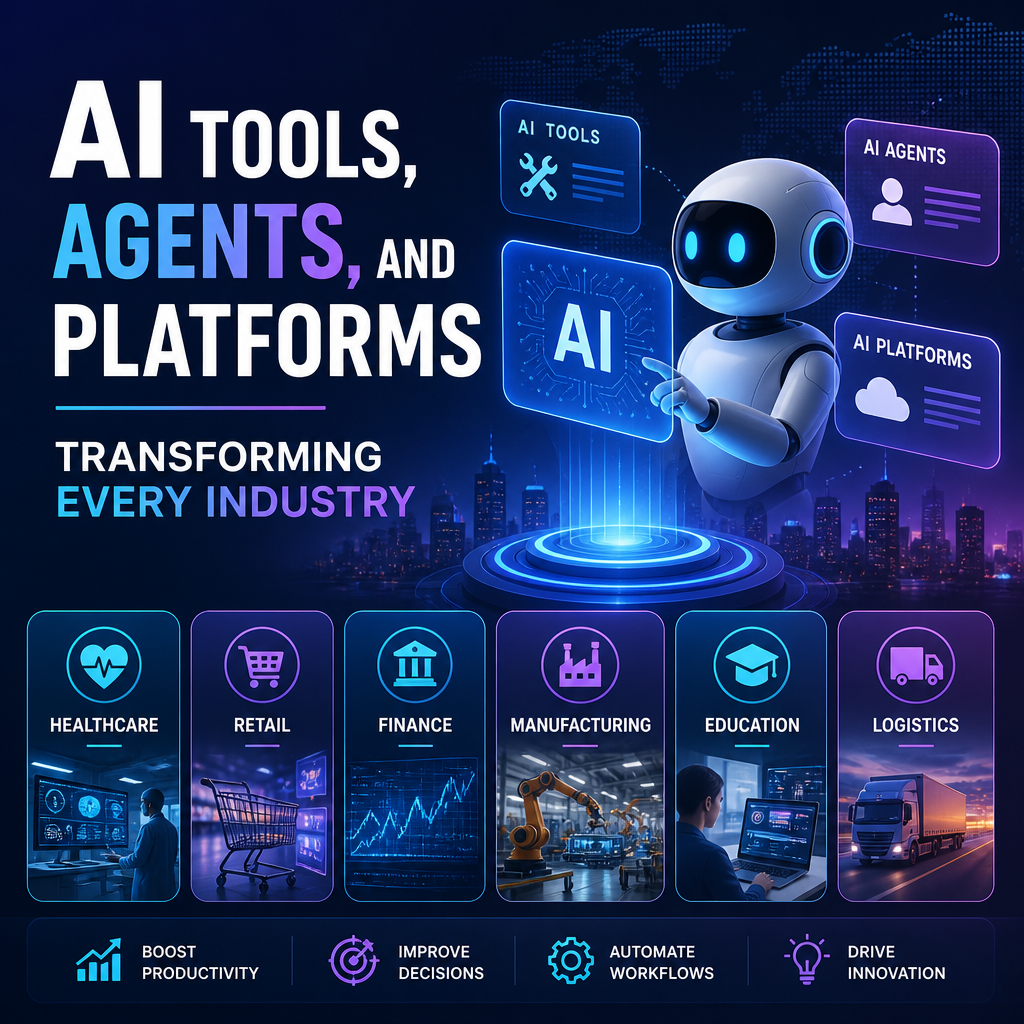
AI Tools, Agents, and Platforms Transforming Every Industry
AI Tools, Agents, and Platforms Transforming Every Industry
Artificial intelligence has moved from experimental technology to a practical force reshaping how organizations operate. Across healthcare, finance, education, manufacturing, retail, and professional services, businesses are using AI tools, agents, and platforms to automate tasks, improve decisions, and create more personalized experiences.
The most important shift is not simply the arrival of smarter software. It is the growing ability of AI systems to understand context, work with large amounts of information, and take action on behalf of people and organizations.

The Rise of AI Tools
AI tools are now widely available for everyday business tasks. Generative AI applications can draft emails, summarize reports, create presentations, analyze documents, and produce marketing content in seconds. Data analysis tools help teams identify trends, forecast demand, and detect unusual activity.
Common applications include:

- Customer service chatbots
- Automated meeting summaries
- Predictive analytics
- Image and video generation
- Software development assistants
- Document review and information extraction
- Personalized marketing and recommendations
These tools do not necessarily replace human expertise. Instead, they reduce repetitive work and give employees more time to focus on strategy, creativity, and relationships.
AI Agents Move From Answers to Actions
Traditional software waits for instructions and performs a defined function. AI agents are designed to handle broader goals. They can interpret requests, plan multiple steps, use digital tools, and adjust their approach based on results.

For example, an AI sales agent might research a prospect, update a customer relationship management system, draft a personalized message, and schedule a follow-up. In a supply chain environment, an agent could monitor inventory, identify a potential shortage, compare suppliers, and recommend a response.
Why AI Agents Matter
AI agents can support organizations by:
- Automating multi-step workflows
- Connecting information across different systems
- Responding to changing conditions
- Operating continuously with limited supervision
- Helping employees make faster, better-informed decisions
Human oversight remains essential, especially when decisions involve sensitive data, financial risk, safety, or legal consequences. The most effective implementations combine autonomous action with clear approval rules and monitoring.
Industry Transformation in Practice
Healthcare
Healthcare organizations are using AI to assist with medical imaging, patient scheduling, clinical documentation, and drug discovery. AI can help identify patterns in scans, summarize patient histories, and reduce administrative workloads for clinicians.
The goal is not to remove the human element from care. Rather, AI gives medical professionals better information and more time to focus on patients.
Finance
Banks and financial institutions use AI for fraud detection, credit analysis, customer support, and investment research. Systems can examine transactions in real time and flag activity that may require investigation.
AI also enables more personalized financial guidance, although transparency and regulatory compliance are critical when automated systems influence financial decisions.
Manufacturing
In manufacturing, AI supports predictive maintenance, quality control, robotics, and production planning. Sensors can identify signs of equipment failure before a breakdown occurs, reducing downtime and repair costs.
Computer vision systems can inspect products more consistently, while AI-powered planning tools help manufacturers respond to changing demand.
Retail and Marketing
Retailers use AI to personalize product recommendations, manage inventory, optimize pricing, and improve customer service. Marketing teams can analyze audience behavior and create content tailored to specific segments.
AI agents may also assist with campaign planning, performance monitoring, and customer engagement across multiple channels.
Education
Schools and training organizations are adopting AI for personalized learning, tutoring, grading assistance, and administrative support. Adaptive platforms can adjust lessons according to a learner’s progress and provide immediate feedback.
Educators remain central to the learning process, but AI can help them identify areas where students need additional support.
The Role of AI Platforms
AI platforms provide the infrastructure needed to develop, deploy, and manage intelligent applications. They often include machine learning models, data tools, application programming interfaces, security features, and monitoring capabilities.
For businesses, platforms make it easier to connect AI with existing systems rather than building every solution from scratch. This supports faster experimentation while helping organizations establish consistent standards for privacy, access, and performance.
Challenges and Responsible Adoption
Despite its potential, AI introduces important challenges. Organizations must address data privacy, cybersecurity, bias, inaccurate outputs, intellectual property, and workforce changes.
A responsible AI strategy should include:
- Clear governance policies
- Human review for high-impact decisions
- Regular testing and auditing
- Secure data management
- Employee training
- Transparent communication with customers and staff
Companies that treat AI as a long-term capability rather than a short-lived trend will be better prepared to manage both its opportunities and its risks.
The Future of Intelligent Work
AI tools, agents, and platforms are becoming part of the standard technology landscape. Their influence will continue to expand as systems become more capable, connected, and specialized.
The organizations most likely to succeed will not be those that automate everything blindly. They will be the ones that combine intelligent technology with human judgment, strong leadership, and responsible design. Across every industry, AI is becoming less of a distant possibility and more of a practical partner in how work gets done.