
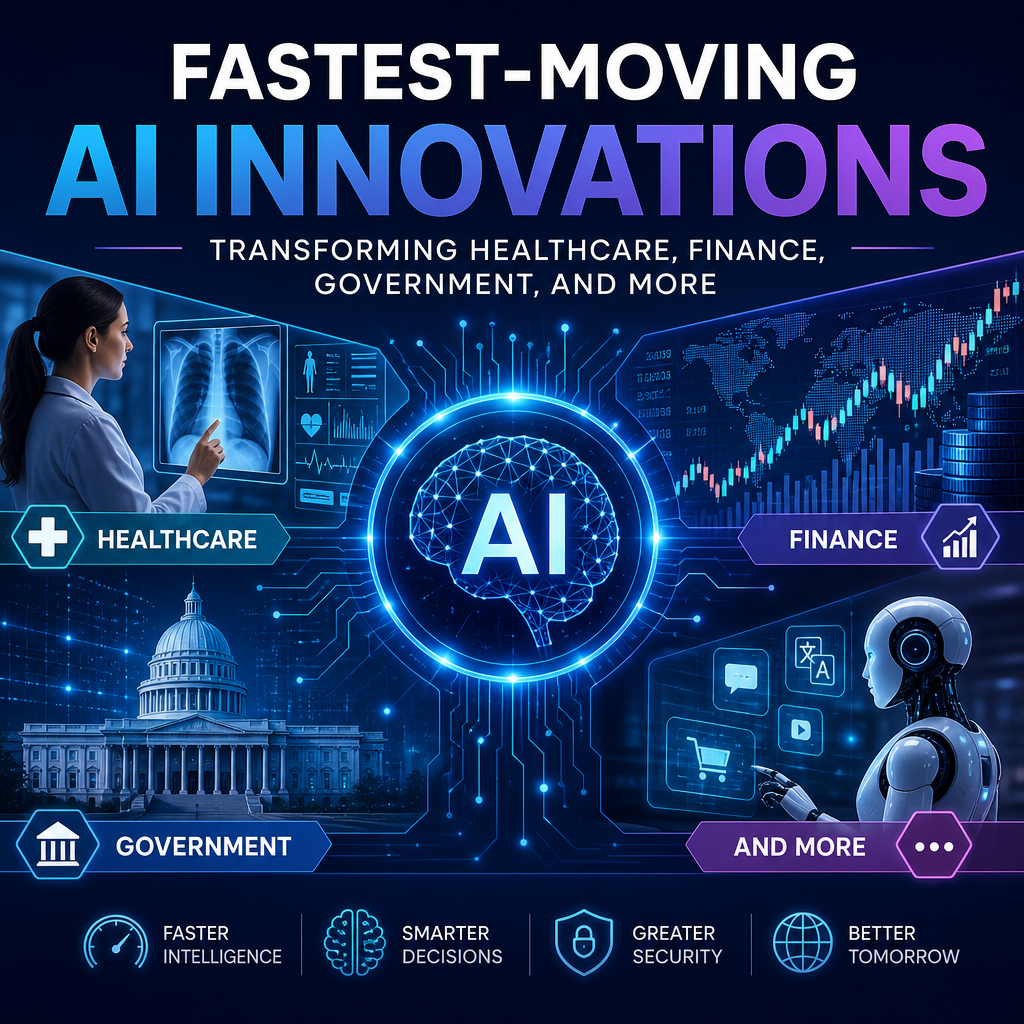
Fastest-Moving AI Innovations Transforming Healthcare, Finance, Government, and More
The Fastest-Moving AI Innovations in Healthcare, Finance, Government, and More
Artificial intelligence is moving from experimental technology to everyday infrastructure. Across healthcare, finance, government, retail, manufacturing, and education, organizations are adopting AI to automate routine work, improve decisions, and deliver more personalized services.
The fastest-moving AI innovations are not limited to futuristic robots or fully autonomous systems. Many are practical tools already changing how people work and how businesses serve their customers.

AI in Healthcare
Healthcare is one of the most promising areas for artificial intelligence. AI systems can analyze enormous amounts of medical data, helping professionals identify patterns that may be difficult to detect manually.
Faster Diagnosis and Medical Imaging
AI-powered imaging tools assist radiologists and other specialists by reviewing X-rays, CT scans, MRIs, and ultrasound images. These systems can flag potential abnormalities, allowing clinicians to prioritize urgent cases and make faster assessments.

AI is also being used to support early detection of conditions such as cancer, heart disease, and neurological disorders. While these tools do not replace medical professionals, they can improve accuracy and reduce delays.
Personalized Treatment
Another important innovation is the use of AI to tailor treatment plans. By analyzing patient histories, genetic information, lifestyle factors, and treatment outcomes, AI can help doctors select therapies that are more likely to work for specific individuals.

AI-powered virtual assistants are also helping patients schedule appointments, receive medication reminders, and find answers to common health questions.
AI in Finance
Financial institutions have adopted AI rapidly because the industry produces vast amounts of structured data and depends on quick, accurate decisions.
Fraud Detection and Risk Management
AI algorithms monitor transactions in real time, identifying unusual spending patterns and possible fraud. Unlike traditional rule-based systems, modern models can learn from new behaviors and adapt as criminal tactics change.
Banks and insurers also use AI to assess credit risk, detect money laundering, and improve compliance processes. These applications can reduce financial losses while making investigations more efficient.
Automated Financial Guidance
AI-powered financial tools can analyze income, spending, investments, and market conditions to offer customized insights. Consumers may use these systems for budgeting, savings plans, or investment research.
Generative AI is also helping financial employees summarize reports, draft communications, and search internal documents. Strong oversight remains essential, particularly when AI influences lending, investments, or other high-impact decisions.
AI in Government
Government agencies are increasingly using AI to improve public services and manage large administrative workloads.
More Efficient Public Services
AI can help process applications, organize records, answer routine questions, and identify service delays. Chatbots and virtual agents provide citizens with information about permits, benefits, taxes, and public programs at any time.
In emergency management, AI can analyze weather data, satellite imagery, and infrastructure information to support disaster preparation and response.
Responsible Use and Public Trust
Government adoption also raises important questions about privacy, transparency, bias, and accountability. Public agencies must explain how automated systems make decisions and ensure that citizens have meaningful ways to challenge errors.
Clear rules, human review, strong cybersecurity, and careful data governance are essential for building trust in government AI.
AI in Retail and Manufacturing
Retailers use AI to predict demand, personalize recommendations, optimize pricing, and improve customer service. Generative AI can create product descriptions, marketing content, and shopping assistants tailored to individual preferences.
In manufacturing, computer vision systems inspect products for defects, while predictive maintenance tools analyze equipment data to identify problems before machines fail. These applications can reduce waste, improve worker safety, and increase productivity.
AI in Education and the Workplace
Educational institutions are experimenting with AI tutors, personalized learning platforms, and automated feedback tools. These systems can adjust lessons to match a student’s pace and provide additional support where needed.
Across the broader workplace, AI is becoming a daily productivity assistant. Employees use it to summarize meetings, analyze documents, write code, conduct research, and automate repetitive tasks.
The most effective organizations are not treating AI simply as a replacement for human workers. Instead, they are combining machine speed and scale with human judgment, creativity, empathy, and accountability.
The Road Ahead
The fastest-moving AI innovations are transforming industries because they solve practical problems today. They help professionals work more efficiently, make complex information easier to understand, and improve access to essential services.
However, successful adoption requires more than advanced software. Organizations must invest in security, employee training, reliable data, ethical standards, and ongoing evaluation. As AI becomes more powerful, responsible implementation will be just as important as technical innovation.
The future of AI will likely be defined not by one breakthrough, but by its steady integration into the systems people use every day.