Samsung DVM S2+ AI-Powered VRF HVAC System for Energy Efficiency
Samsung DVM S2+: An AI-Powered VRF HVAC System for More Efficient Building Comfort
As buildings become more complex and energy efficiency becomes a higher priority, heating, ventilation and air-conditioning systems are evolving beyond traditional controls. Samsung’s DVM S2+ is a new commercial variable refrigerant flow (VRF) HVAC system designed to deliver responsive climate control across residential, commercial and mixed-use buildings.
The system combines R-32 refrigerant, embedded Wi-Fi and on-device artificial intelligence to adjust operation in real time. Rather than relying only on fixed control settings or cloud-based analytics, the DVM S2+ processes operating information directly on the outdoor unit. It can then modify refrigerant pressure, capacity and scheduling to respond to changing occupancy, weather and building-load conditions.

Samsung Electronics America is expected to bring the DVM S2+ to market on March 31, 2027. With a suggested retail price of approximately $15,000, the system is positioned as a high-capacity HVAC solution for buildings that require multi-zone comfort, efficient operation and intelligent system management.
Product Overview
The Samsung DVM S2+ is a variable refrigerant flow system capable of supporting capacities from approximately 6 to 20 tons. VRF technology allows a single outdoor system to serve multiple indoor units, with each zone receiving the amount of heating or cooling it needs.

This approach is particularly useful in buildings where conditions vary from room to room. For example:
- An office conference room may need intensive cooling during a meeting.
- A hallway may require very little conditioning.
- A sun-facing apartment may experience a higher cooling load than a shaded room.
- Retail spaces may have changing demand throughout the day as customers enter and leave.
By distributing refrigerant according to individual zone requirements, a VRF system can reduce the energy waste associated with operating a conventional system at a single, fixed level.

The DVM S2+ is designed for use with Samsung’s WindFree™ indoor units. These units distribute conditioned air through thousands of micro-perforations, helping reduce the uncomfortable drafts associated with traditional direct airflow. The result is a more diffuse and consistent indoor environment.
Engineering and Intelligent Operation
The core engineering advancement of the DVM S2+ is its use of on-device AI. An embedded application processor analyzes system conditions locally and uses that information to make ongoing control decisions.
Traditional HVAC controls often depend on predetermined parameters. While these settings can provide reliable operation, they may not respond efficiently when occupancy, outdoor temperature or building loads change unexpectedly. The DVM S2+ is designed to continuously adapt instead.
AI Adaptive Control
AI Adaptive Control estimates current building demand and environmental conditions, then adjusts refrigerant flow and system capacity. This can help the system maintain target temperatures without running compressors harder or longer than necessary.
For example, if a building begins to fill with occupants during the morning, the system can respond to the increased cooling demand. Conversely, when a section of the building becomes vacant, it can reduce capacity in that area rather than continuing to operate at the previous level.
This type of dynamic adjustment is intended to provide two benefits:
- More consistent indoor temperatures.
- Lower energy consumption during periods of reduced demand.
AI Pre-Conditioning
AI Pre-Conditioning is designed to help spaces reach a selected temperature at a desired time. Instead of starting at the exact moment a schedule begins, the system can estimate how much time is needed to prepare the space.
If an office is scheduled to open at 8:00 a.m., for instance, the system may begin heating or cooling early enough to achieve the target temperature by that time. If weather conditions or previous building conditions suggest that less preparation is necessary, operation can be adjusted accordingly.
This approach can help avoid excessive runtime while improving comfort when occupants arrive.
AI Energy Manager
The AI Energy Manager monitors overall system energy consumption and adjusts operation to help control demand. It is designed to balance comfort requirements with energy-use targets across the connected zones.
In a mixed-use building, this could mean managing different operating needs in apartments, offices, corridors or shared spaces. Rather than treating the entire building as one uniform load, the system can use available operating information to support more targeted energy management.
Because these AI features operate on the outdoor unit, control decisions do not need to depend continuously on external cloud processing. This can support fast responses and allow core optimization functions to continue even when external connectivity is limited.
R-32 Refrigerant and Environmental Considerations
The DVM S2+ uses R-32 refrigerant, which has a substantially lower global warming potential than R-410A. According to the product information, R-32 has approximately 67% lower global warming potential than R-410A and can require a lower refrigerant charge.
Refrigerant selection is increasingly important as building owners, engineers and regulators seek to reduce the environmental impact of HVAC equipment. The use of R-32 contributes to that goal while supporting the system’s intended efficiency improvements.
Environmental performance also depends on installation quality, maintenance, building design and operating conditions. However, selecting a refrigerant with lower global warming potential is an important part of reducing the life-cycle impact of a large HVAC system.
The DVM S2+ combines this refrigerant choice with AI-based energy management. Reducing unnecessary compressor operation and improving load distribution may help decrease electricity consumption over the system’s operating life.
Design and User Experience
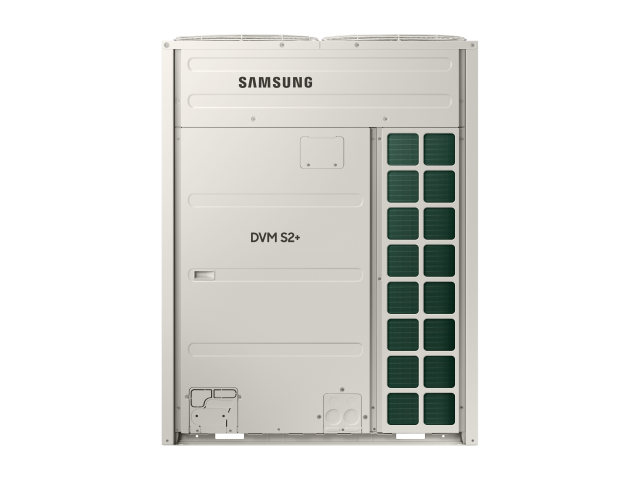
As an outdoor commercial HVAC system, the DVM S2+ is designed primarily for functional integration rather than visual prominence. Its large, modular form supports installations in a variety of building types, including apartment complexes, offices, retail properties and mixed-use developments.
The listed dimensions are:
- Length: 30.1 inches
- Width: 73.2 inches
- Height: 66.7 inches
- Weight: Approximately 900 pounds
These dimensions and weight reflect the system’s commercial scale. Installation planning will be important, particularly for rooftop placements, mechanical areas and projects that require multiple outdoor units.
The user experience is most noticeable indoors. When paired with WindFree™ indoor units, the system is designed to provide cooling through micro-perforations rather than a strong, concentrated stream of air. This may be useful in spaces occupied by people who are sensitive to drafts, including infants, older adults and individuals who find direct cold air uncomfortable.
Embedded Wi-Fi also simplifies connectivity. Because Wi-Fi is built into the system, an additional communication module may not be required for network access. This can help streamline installation and support ongoing system monitoring and management.
Three Defining Innovations
1. On-Device AI Processing
The DVM S2+ extends Samsung’s previous VRF platform by adding an embedded application processor capable of running AI-driven controls directly on the outdoor unit.
This local processing approach allows the system to analyze operating conditions and make adjustments in real time. It distinguishes the product from systems that rely primarily on static control logic or remote cloud-based analysis.
2. Integrated Energy and Comfort Management
The product combines three AI functions—Adaptive Control, Pre-Conditioning and Energy Manager—to address different aspects of HVAC operation.
Together, these technologies are designed to:
- Improve temperature consistency.
- Reduce unnecessary compressor operation.
- Prepare spaces for occupancy more efficiently.
- Adapt to changing loads.
- Help control total energy use.
The system therefore treats comfort and efficiency as connected goals rather than separate functions.
3. Lower-Impact Refrigerant and Draft-Reduced Airflow
The use of R-32 refrigerant gives the DVM S2+ a lower global warming potential compared with systems using R-410A. At the indoor-unit level, compatibility with WindFree™ technology supports a more indirect airflow pattern.
This combination addresses both environmental and occupant concerns. The outdoor system is designed to reduce refrigerant impact and energy waste, while the indoor units are designed to improve the comfort of people using the space.
Intended Applications
The DVM S2+ is suitable for projects that need centralized control with independent zone management. Potential applications include:
- Multifamily residential buildings
- Office developments
- Hotels and hospitality properties
- Retail buildings
- Educational facilities
- Healthcare-adjacent facilities
- Mixed-use towers
- High-rise residential projects
Its 6- to 20-ton capacity range allows designers to consider the system for a broad selection of building sizes and layouts. The ability to connect multiple indoor units can also reduce the need for separate standalone systems throughout a property.
For building owners, the value may extend beyond temperature control. Intelligent operation can support energy-management goals, while integrated connectivity can make system oversight easier for facility teams.
Technical Specifications
| Specification | Details |
|---|---|
| Product name | Samsung DVM S2+ |
| Model number | AM240HCVGJS2AA |
| Product type | Variable refrigerant flow HVAC system |
| Refrigerant | R-32 |
| Capacity | 6–20 tons |
| Length | 30.1 inches |
| Width | 73.2 inches |
| Height | 66.7 inches |
| Weight | Approximately 900 pounds |
| Connectivity | Embedded Wi-Fi |
| Intelligent controls | On-device AI driven by an embedded application processor |
| Suggested retail price | Approximately $15,000 |
| Projected market date | March 31, 2027 |
| Company | Samsung Electronics America |
| Website | Samsung |
What the Product Could Mean for Building Owners
The DVM S2+ is designed for a future in which HVAC systems respond continuously to actual building conditions. Rather than requiring users to make frequent manual adjustments, the system can use data about temperature, occupancy patterns and system performance to optimize operation automatically.
For building owners, this may lead to more predictable comfort and improved energy management. For occupants, the advantages may be felt through fewer temperature swings and reduced drafts. For facility managers, embedded Wi-Fi and AI-based monitoring can simplify oversight across multiple zones.
Actual performance will depend on building envelope design, installation, climate, maintenance and operating schedules. Nevertheless, the product’s combination of VRF flexibility, local AI, R-32 refrigerant and WindFree™ compatibility gives it a distinct position in the commercial HVAC market.
Conclusion
Samsung’s DVM S2+ is a new VRF HVAC platform that brings on-device AI to commercial climate control. Its AI Adaptive Control, AI Pre-Conditioning and AI Energy Manager features are designed to improve comfort while reducing unnecessary energy use. The system also uses lower-impact R-32 refrigerant, includes embedded Wi-Fi and supports Samsung WindFree™ indoor units for draft-reduced airflow.
Projected for release on March 31, 2027, the DVM S2+ represents Samsung’s effort to combine intelligent automation, environmental responsibility and flexible multi-zone comfort in a single commercial HVAC solution.