Real-Time News Intelligence: Combining AI Filtering With Human Expertise
Real-Time News Intelligence: How AI Filtering and Human Expertise Work Together
The modern news cycle moves faster than ever. Breaking developments can spread across social media, news sites, press releases, videos, and public records within minutes. For organizations that rely on timely information, keeping up is no longer simply a matter of reading more. It requires a smarter process.
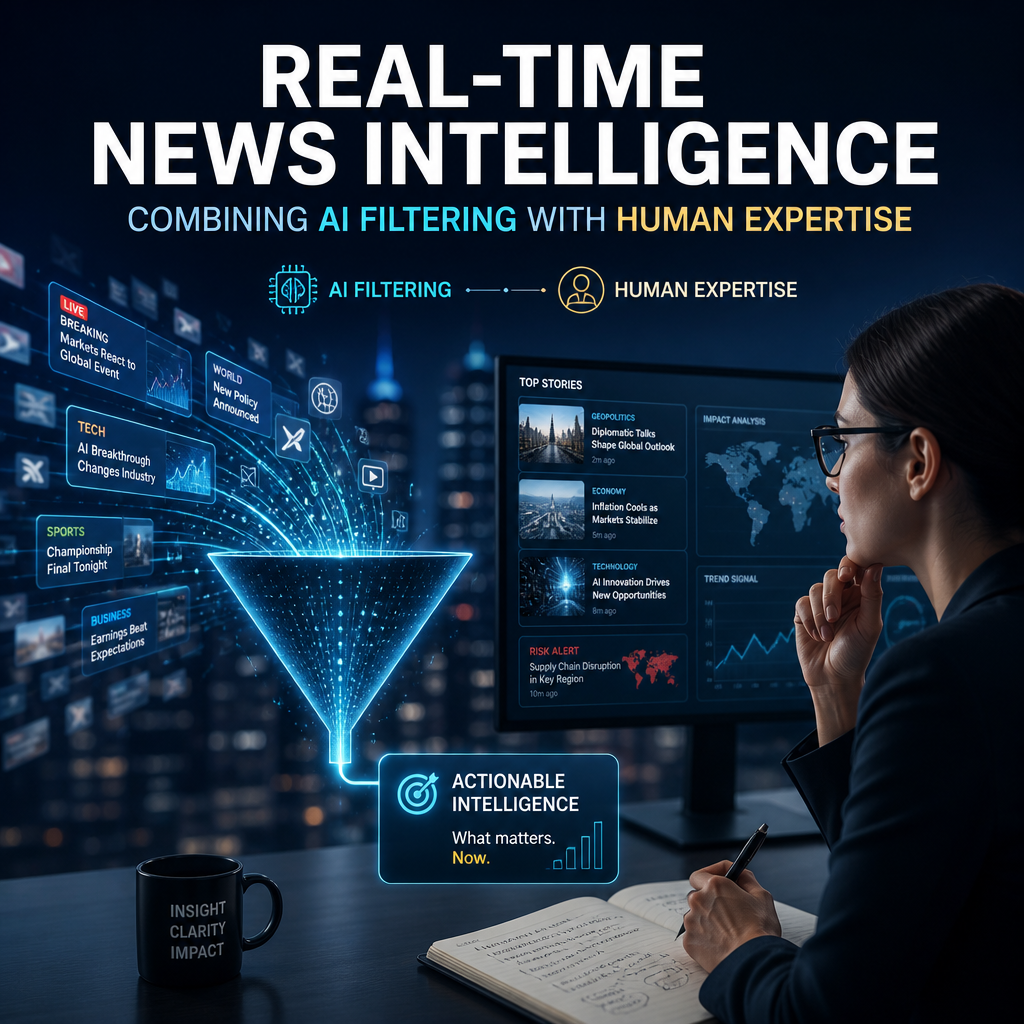
Real-time news intelligence combines artificial intelligence with human expertise to identify important developments, reduce noise, and provide meaningful context. AI helps process enormous volumes of information, while experienced analysts bring judgment, interpretation, and credibility to the results.

The Challenge of Information Overload
Every day, thousands of articles, posts, reports, and alerts compete for attention. Much of this content may be duplicated, outdated, speculative, or irrelevant to a particular organization.
Traditional monitoring methods often create two problems:

- Too much noise: Teams receive more alerts than they can reasonably review.
- Missed signals: Important developments may be buried beneath less relevant content.
- Limited context: A headline may identify an event without explaining its wider significance.
- Slow response times: Manual research can delay decisions when speed matters most.
Real-time news intelligence addresses these challenges by combining automated discovery with expert analysis.
How AI Filtering Improves News Monitoring
Artificial intelligence can scan and process information at a scale that human teams cannot match. Machine learning systems monitor multiple sources continuously, identifying patterns and potential relevance in real time.

AI filtering typically helps with several key tasks:
Monitoring Multiple Sources
An AI-powered platform can track digital publications, industry websites, government announcements, social networks, broadcast transcripts, and other sources simultaneously. This broad coverage makes it easier to detect emerging stories early.
Identifying Relevant Content
Natural language processing allows systems to recognize names, organizations, locations, topics, and relationships. Instead of relying only on exact keywords, AI can assess meaning and identify related terms or concepts.
For example, a monitoring system tracking a company may detect references to a new product, executive, subsidiary, or regulatory issue even when the organization’s full name is not used.
Removing Duplicates and Low-Value Content
The same event may appear in dozens of outlets. AI can group duplicate reports and identify recycled content, helping teams focus on the original development rather than reviewing every repetition.
Automated filtering can also reduce promotional material, irrelevant mentions, and routine updates that do not require immediate attention.
Detecting Trends and Anomalies
AI systems can compare current coverage with historical patterns. A sudden increase in mentions, a change in sentiment, or a new association between organizations may indicate an emerging issue.
These signals can be especially valuable when a story has not yet become a major headline.
Why Human Expertise Still Matters
Despite its capabilities, AI cannot fully replace human judgment. Algorithms can identify patterns, but they do not always understand intent, cultural context, credibility, or strategic importance.
Human analysts provide the layer of interpretation that turns raw information into intelligence.
Evaluating Source Credibility
Not every source carries the same authority. A confirmed government announcement, an established publication, an anonymous social media post, and an unverified blog should not receive equal weight.
Experienced professionals assess the reliability of sources, compare conflicting accounts, and identify whether a claim is supported by evidence.
Understanding Context
A single statement can have different meanings depending on the circumstances. Analysts consider previous events, industry conditions, political developments, and organizational history before deciding how significant a report may be.
This context helps decision-makers avoid reacting too quickly to incomplete or misleading information.
Prioritizing What Matters
AI can rank content based on programmed criteria, but human experts can judge business impact more thoughtfully. A seemingly minor regulatory announcement may be highly important to one organization, while a widely discussed story may have little practical relevance.
Human review ensures that alerts reflect real priorities rather than engagement metrics alone.
The Best Results Come From Collaboration
The strongest real-time news intelligence programs use AI and human expertise together rather than treating them as competing approaches.
AI handles the speed, scale, and consistency of monitoring. Humans manage interpretation, verification, and strategic relevance. This division of responsibilities creates a more efficient workflow:
- AI scans and collects information.
- Automated filters organize and prioritize potential signals.
- Human analysts verify important developments.
- Experts add context, implications, and confidence levels.
- Decision-makers receive concise, actionable intelligence.
This process allows teams to respond quickly without sacrificing accuracy.
Building a More Reliable Intelligence Process
Organizations can improve their approach by defining clear monitoring goals and review standards. Useful steps include:
- Identify the topics, competitors, risks, and markets that matter most.
- Use AI tools to monitor a broad range of relevant sources.
- Establish rules for urgency, credibility, and escalation.
- Require human review for high-impact or uncertain reports.
- Regularly refine filters based on false positives and missed signals.
- Present findings in concise summaries that explain both facts and implications.
The goal is not to collect every available mention. It is to surface the information that can support better decisions.
A Smarter Future for News Monitoring
Real-time news intelligence is becoming an essential capability for businesses, public institutions, and professionals operating in fast-changing environments. AI makes it possible to monitor information continuously, while human expertise ensures that speed does not come at the expense of judgment.
Together, these technologies and skills create a balanced approach: automated enough to keep pace with the news cycle and thoughtful enough to understand what the news really means.