
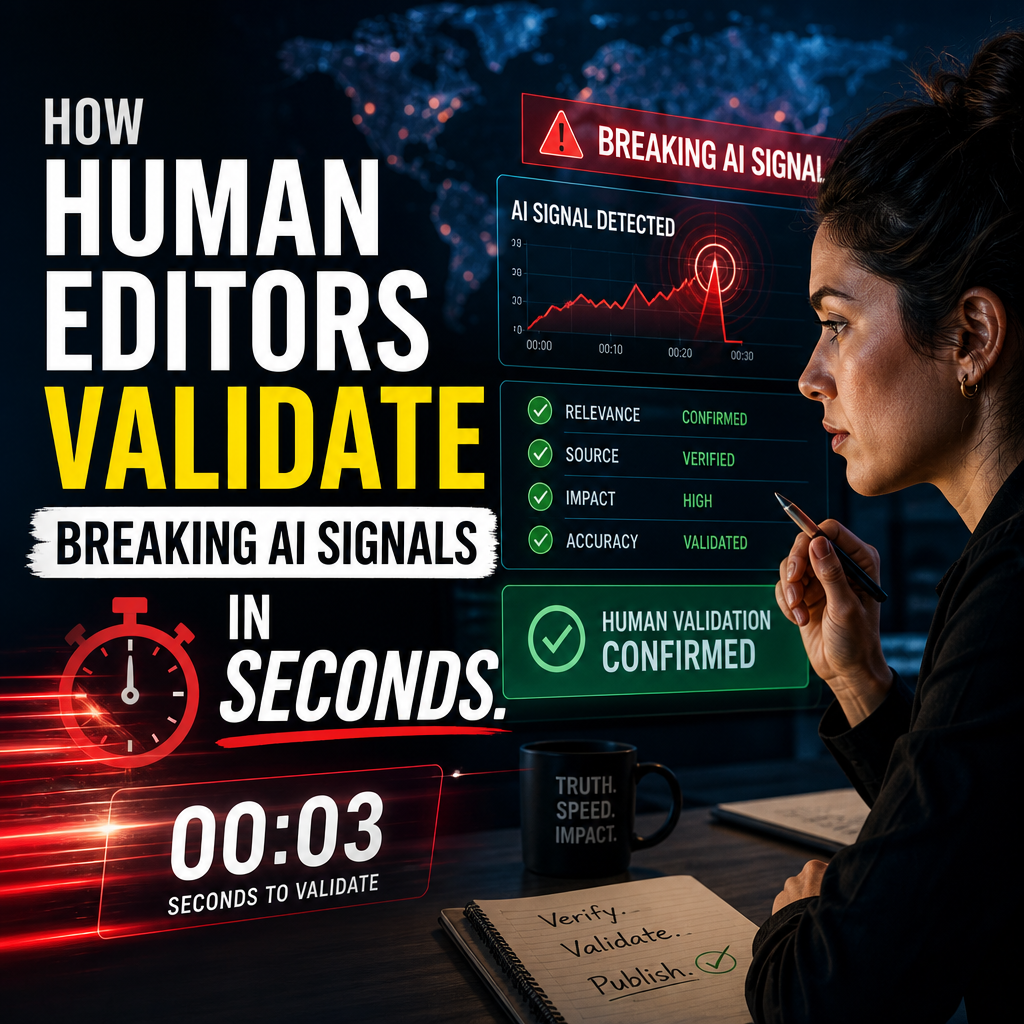
How Human Editors Validate Breaking AI Signals in Seconds
How Human Editors Validate Breaking AI Signals in Seconds
Breaking news no longer arrives only through reporters, press releases, or official statements. Artificial intelligence systems now scan social platforms, public databases, livestreams, satellite images, and online communities for unusual activity. These tools can detect potential events within seconds—but detection is not the same as confirmation.
That is where human editors matter. They bring context, skepticism, and judgment to breaking AI signals before those signals become headlines.

What Counts as a Breaking AI Signal?
A breaking AI signal is an automated alert suggesting that something important may be happening. It could include:
- A sudden spike in posts about an event
- A developing weather or natural disaster pattern
- An unusual movement in financial markets
- A new government announcement or legal filing
- A viral image or video tied to a developing story
- A disruption reported across multiple services
AI systems are particularly good at identifying changes from normal patterns. They can compare millions of data points, recognize keywords, track locations, and flag unusual activity far faster than a person could.

However, an alert often represents a possibility, not a fact. A sudden surge in online discussion might indicate a major event—or a coordinated campaign, recycled content, joke, misunderstanding, or technical error.
The First Step: Assessing the Signal
When an alert arrives, editors first determine what exactly triggered it. They examine the source, timestamp, location, volume, and confidence level attached to the signal.

This initial review helps answer several questions:
- Is the information coming from a reliable source?
- Is the activity genuinely new?
- Are multiple independent sources reporting the same development?
- Could a technical issue or algorithmic bias explain the alert?
- Does the signal match known events or trends?
Speed matters, but editors avoid treating urgency as proof. A strong signal deserves rapid attention, not automatic publication.
Separating Original Evidence From Recycled Content
One of the most common problems in breaking coverage is recycled material presented as new. Old videos, photographs, and screenshots can resurface during a current crisis and quickly gain millions of views.
Human editors verify the content by checking:
- Reverse-image and video searches
- Visible landmarks, signs, weather, and terrain
- Upload history and earliest known publication
- Metadata, when available
- Reports from trusted local sources
- Geolocation and mapping tools
Editors also watch for altered media. Cropping, editing, dubbing, and artificial generation can change the meaning of authentic material. Even genuine footage may be incorrectly labeled by users who do not know where or when it was recorded.
Cross-Checking Independent Sources
A single account can be mistaken. Several accounts repeating the same claim may still be repeating one original error. Human editors therefore look for independence rather than simple volume.
They compare AI signals with:
- Official agency statements
- Local reporters and eyewitnesses
- Emergency service updates
- Public records and institutional websites
- Verified livestreams
- Historical and geographic context
The goal is not to collect as many mentions as possible. It is to establish whether the evidence comes from separate sources that arrived at the same conclusion independently.
Applying Context the Algorithm Cannot See
AI can identify patterns, but it may not understand why those patterns are occurring. A spike in searches could reflect a school assignment, a planned event, a celebrity mention, or a real emergency. A market movement might result from a scheduled announcement rather than an unexpected development.
Editors add context by asking what was already known before the alert appeared. They review calendars, previous coverage, regional conditions, and relevant background information.
This step prevents misleading headlines based on technically accurate but incomplete signals.
Deciding What Can Be Published
Once editors assess the evidence, they classify the information. It may be:
- Confirmed: Supported by reliable, independent evidence
- Probable: Strongly indicated but missing final confirmation
- Unverified: Plausible but not adequately supported
- False or misleading: Contradicted by credible evidence
This classification shapes the language used in coverage. A confirmed event may warrant a direct headline. A developing or unverified claim requires careful wording, attribution, and transparency about what remains unknown.
Editors also consider potential harm. Publishing an incorrect location, identity, casualty figure, or security detail can create real-world consequences. Verification is therefore both a journalistic standard and a safety responsibility.
Why Human Judgment Still Matters
AI dramatically improves the speed of discovery, but human editors provide the final layer of accountability. They challenge assumptions, recognize manipulation, interpret nuance, and decide whether evidence is strong enough for publication.
The most effective breaking-news process combines both strengths:
- AI detects unusual signals quickly.
- Editors investigate the underlying evidence.
- Independent sources are cross-checked.
- Context and uncertainty are added.
- Only verified, responsibly framed information is published.
In a fast-moving information environment, the advantage is not simply being first. It is being first without sacrificing accuracy. Human editors make that balance possible, validating breaking AI signals in seconds while protecting audiences from confusion, recycled claims, and false urgency.