
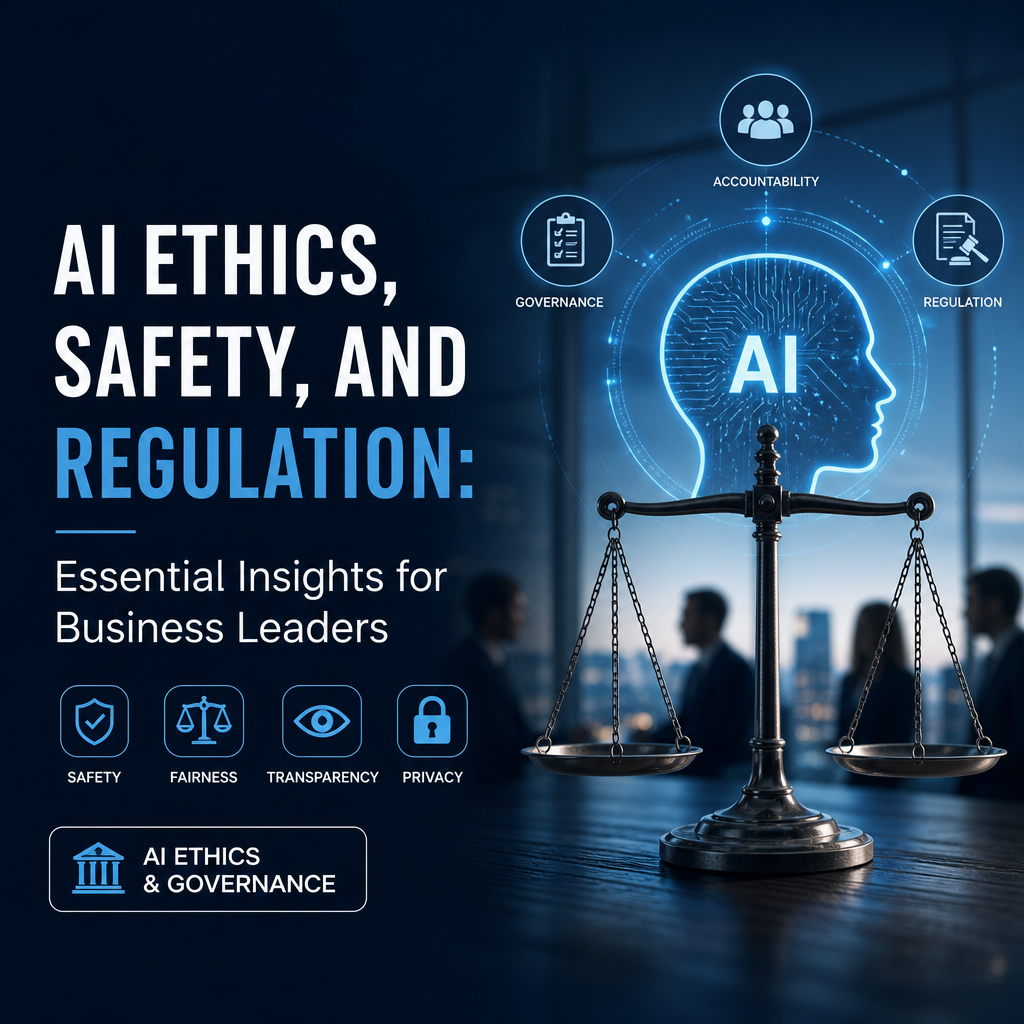
AI Ethics, Safety, and Regulation: Essential Insights for Business Leaders
AI Ethics, Safety, and Regulation: What Every Leader Needs to Know
Artificial intelligence is rapidly changing how organizations serve customers, manage operations, make decisions, and compete. Yet the value of AI depends on more than technical performance. Leaders must also ensure that AI systems are fair, secure, explainable, and used responsibly.
Understanding AI ethics, safety, and regulation is no longer limited to legal or technology teams. It is a core leadership responsibility that affects reputation, compliance, employee trust, and long-term business resilience.

Why AI Governance Matters
AI systems can process vast amounts of data and make recommendations at a scale that humans cannot match. However, they may also reproduce biased data, expose sensitive information, generate inaccurate content, or make decisions that are difficult to challenge.
Poorly governed AI can create several risks:

- Discrimination in hiring, lending, healthcare, or customer service
- Privacy violations caused by inappropriate data collection or use
- Cybersecurity vulnerabilities and malicious manipulation
- Incorrect or misleading outputs
- Lack of accountability when automated decisions cause harm
- Regulatory penalties and reputational damage
Responsible governance helps organizations capture AI’s benefits while reducing these risks. It also creates clearer expectations for employees, vendors, and business partners.
The Core Principles of Ethical AI
Although specific frameworks differ, most responsible AI programs are built around several common principles.

Fairness and Non-Discrimination
AI systems should not unfairly disadvantage people based on characteristics such as race, gender, age, disability, or socioeconomic background. Leaders should examine training data, test outcomes across demographic groups, and monitor systems after deployment.
Fairness does not happen automatically. It requires measurable standards, regular audits, and processes for correcting harmful results.
Transparency and Explainability
People affected by an AI-assisted decision should understand, at an appropriate level, how that decision was made. Total technical transparency may not always be possible, but organizations should document the system’s purpose, data sources, limitations, and decision-making role.
Clear explanations are especially important in high-impact areas such as employment, insurance, education, finance, and healthcare.
Privacy and Data Protection
AI projects often rely on large datasets, making data governance essential. Leaders should confirm that data is collected lawfully, used for legitimate purposes, protected from unauthorized access, and retained only as long as necessary.
Practical safeguards include:
- Data minimization
- Access controls
- Encryption
- Anonymization or pseudonymization
- Vendor assessments
- Clear retention and deletion policies
Accountability and Human Oversight
Organizations must identify who is responsible for an AI system throughout its lifecycle. Human oversight should be meaningful, not merely symbolic.
Employees need the authority and training to question, override, or suspend an AI system when its output appears unsafe, inaccurate, or unfair. Accountability should remain with the organization, even when a third-party tool is involved.
Understanding AI Safety
AI safety focuses on preventing systems from causing unintended harm. This includes both technical failures and misuse.
Before deployment, organizations should evaluate whether a system can:
- Produce unreliable or fabricated information
- Reveal confidential data
- Be manipulated through malicious inputs
- Behave unpredictably in unusual situations
- Make high-impact decisions without adequate review
- Create new risks when integrated with other systems
Testing should continue after launch. AI models may behave differently as users, data, or operating conditions change. Continuous monitoring, incident reporting, and regular reassessment are essential parts of a mature safety program.
The Growing Regulatory Landscape
Governments worldwide are introducing rules and standards for AI. Requirements vary by location and industry, but many focus on risk classification, transparency, privacy, documentation, human oversight, and restrictions on certain uses.
Leaders should not treat regulation as a one-time compliance exercise. Instead, they should establish processes that can adapt as laws and guidance evolve.
A practical regulatory strategy includes:
- Maintaining an inventory of AI systems and use cases
- Classifying systems according to potential impact and risk
- Documenting data sources, model behavior, testing, and limitations
- Assigning clear owners for approval and oversight
- Reviewing contracts with AI vendors
- Monitoring legal developments in relevant markets
- Creating procedures for incidents, complaints, and remediation
Building Responsible AI Leadership
Ethical AI begins with organizational culture. Executives should set clear expectations that speed and innovation cannot come at the expense of safety or trust.
Strong leadership includes:
- Establishing an AI governance committee
- Defining acceptable and prohibited uses
- Training employees on responsible AI practices
- Involving legal, security, compliance, technical, and business teams
- Encouraging employees to report concerns without fear of retaliation
- Measuring both performance and potential harm
Leaders should also communicate honestly about what AI can and cannot do. Overpromising capabilities creates unrealistic expectations and increases operational risk.
A Strategic Advantage, Not Just a Constraint
Responsible AI is often viewed as a limitation on innovation. In practice, strong governance can become a competitive advantage. Organizations that earn trust are more likely to attract customers, employees, investors, and partners.
By integrating AI ethics, safety, and regulation into business strategy, leaders can make better decisions, reduce costly failures, and develop systems that are sustainable over the long term. The goal is not simply to deploy AI faster, but to deploy it in ways that are responsible, resilient, and worthy of trust.