
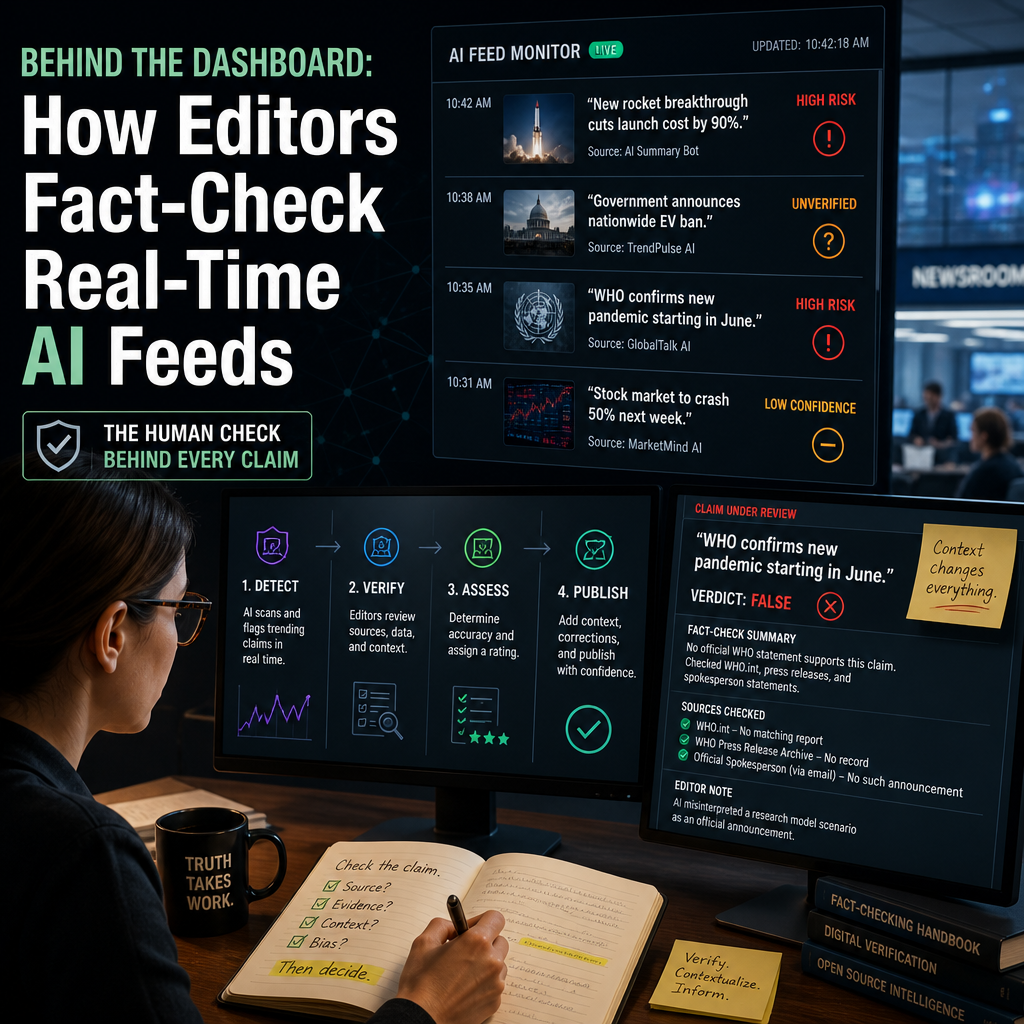
Behind the Dashboard: How Editors Fact-Check Real-Time AI Feeds
Behind the Dashboard: How Our Editorial Team Fact-Checks Real-Time AI Feeds
Real-time AI feeds can deliver breaking information within seconds. They can summarize developments, identify emerging trends, and surface details from sources around the world. But speed alone does not make information reliable.
Behind every trustworthy update is an editorial process designed to test what the system reports. Our team combines automated tools with human judgment to check claims, identify uncertainty, and make sure readers understand what is known, what is developing, and what still needs verification.

Why Real-Time AI Feeds Need Human Oversight
AI systems are excellent at processing large volumes of information quickly. They can compare text, detect repeated phrases, and highlight unusual changes in a developing story. However, they may also reproduce errors, misunderstand context, or treat speculation as fact.
A fast-moving feed can contain:

- Unverified social media posts
- Incomplete official statements
- Outdated background information
- Conflicting reports from different sources
- AI-generated content presented as authentic material
Our editorial team does not treat an AI alert as a published fact. Instead, it becomes a starting point for investigation.
Step One: Identify the Original Claim
The first task is to separate the central claim from the surrounding noise. A feed may summarize several reports at once, making it difficult to determine exactly what has been alleged.

Editors ask basic but essential questions:
- What specifically happened?
- Who is making the claim?
- When and where did it occur?
- Is the information firsthand or repeated from another source?
- What evidence supports it?
This step helps prevent a common problem in breaking news: repeating a vague statement until it appears more credible simply because it has been published multiple times.
Step Two: Trace Information Back to Primary Sources
Whenever possible, we look for the original source rather than relying on summaries or reposts. Depending on the subject, that may include:
- Government agencies and public records
- Court documents
- Company filings and official announcements
- Research papers and institutional reports
- Direct interviews or on-the-record statements
- Verified accounts belonging to relevant organizations
Primary sources are not automatically correct, but they provide clearer evidence and context. An official statement, for example, can confirm what an organization has said without proving that every part of its explanation is accurate.
Comparing Independent Sources
After locating the original claim, editors compare it with independent reporting. We look for agreement on the basic facts, while also noting differences in wording, timing, and interpretation.
Two articles that appear to confirm the same event may actually rely on one shared source. That is not true independent verification. Our team checks sourcing closely to determine whether reports represent separate confirmation or simply a chain of repetition.
Step Three: Test Dates, Numbers, and Context
Many errors are not dramatic fabrications. They are small inaccuracies that change the meaning of a story.
Editors verify details such as:
- Publication dates and time zones
- Names, titles, and locations
- Statistics and percentages
- Historical comparisons
- Images, videos, and their original context
For numerical claims, we examine the underlying data whenever it is available. A percentage may describe a survey subgroup rather than the entire population. A chart may use a truncated scale. A record-breaking claim may depend on a narrow definition.
Context matters just as much as the number itself.
Step Four: Label Uncertainty Clearly
Real-time reporting often develops before all the facts are known. Responsible fact-checking does not mean pretending uncertainty has disappeared. It means communicating uncertainty honestly.
We distinguish between:
- Confirmed information
- Credible but incomplete reports
- Claims under investigation
- Unverified material
- Information contradicted by reliable evidence
This language helps readers understand the status of a story without forcing a premature conclusion. When facts change, we update the article, explain what changed, and preserve a clear record of the correction.
The Role of AI in Our Editorial Workflow
AI remains useful throughout the process. It can flag duplicate claims, find related documents, compare versions of statements, and identify inconsistencies that deserve closer attention.
Still, AI does not make the final editorial decision. Human editors assess source quality, interpret context, and consider the consequences of publishing uncertain information. They also recognize when a technically accurate statement could create a misleading impression.
The goal is not to slow information down unnecessarily. It is to make speed responsible.
Building Trust One Verification at a Time
Fact-checking real-time AI feeds requires patience, skepticism, and clear standards. The dashboard may update every second, but publication should follow evidence rather than excitement.
By tracing claims to their sources, comparing independent reports, checking details, and labeling uncertainty, our editorial team turns rapid information into reporting readers can evaluate and trust. In a world where anyone can circulate an update instantly, careful verification remains one of the most valuable parts of the news process.