
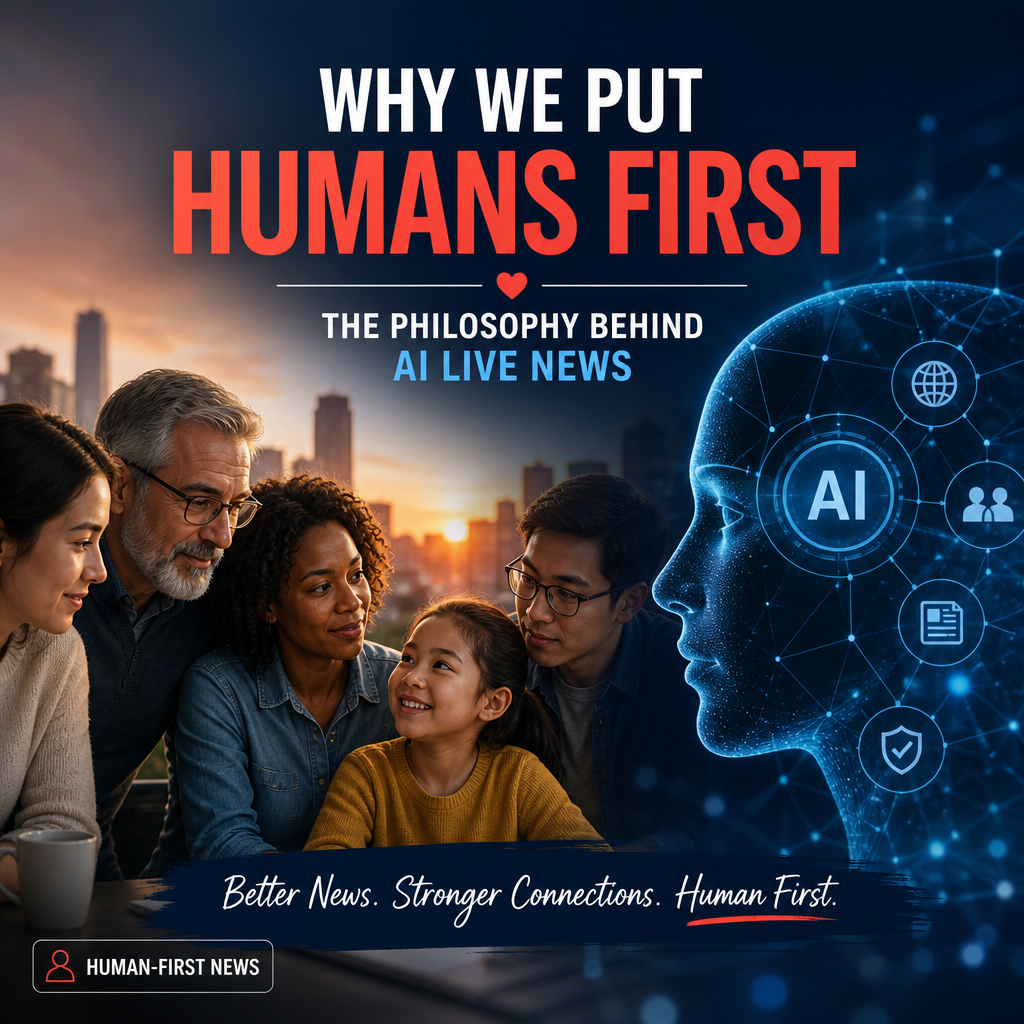
Why We Put Humans First: The Philosophy Behind AI Live News
Why We Put Humans First: The Philosophy Behind AI Live News
News moves quickly, but speed should never come at the expense of people. At AI Live News, our approach begins with a simple belief: technology should serve human understanding, not replace human judgment.
Artificial intelligence can gather information, identify patterns, and help audiences follow developing stories. Yet the meaning of an event, its impact on communities, and the questions it raises still require human attention. That is why our philosophy is built around a human-first model of news.

Technology as a Tool, Not the Story
Artificial intelligence is changing how news is collected and delivered. It can monitor large volumes of information, compare reports, summarize updates, and surface important developments faster than traditional systems alone.
These capabilities are valuable, especially during breaking news events. However, AI is not a substitute for context, accountability, or empathy. It does not experience the consequences of a policy decision, a natural disaster, or a community crisis. People do.

At AI Live News, technology is treated as a tool that supports journalism. Its role is to help people access relevant information efficiently while keeping accuracy, clarity, and public interest at the center.
Putting Context Before Clicks
Fast news can easily become shallow news. A headline may attract attention, but it rarely tells the whole story. Readers need to know not only what happened, but also why it matters and how it connects to broader events.

A human-first approach means valuing:
- Clear explanations over sensational language
- Reliable information over speculation
- Context over isolated headlines
- Public understanding over engagement metrics
- Responsible updates over unnecessary urgency
This does not mean ignoring speed. It means recognizing that speed and quality must work together. The most useful live news helps audiences stay informed without creating confusion or unnecessary fear.
Respecting the People Behind the Headlines
Every news story involves people. They may be families affected by a crisis, workers facing economic change, communities responding to political decisions, or individuals whose experiences are reduced to a brief update.
A human-first philosophy encourages careful language and responsible reporting. It asks us to consider how information may affect those directly involved, as well as the wider audience receiving it.
This includes avoiding misleading claims, protecting privacy when appropriate, and distinguishing confirmed facts from early reports. It also means remembering that accuracy is not merely a technical standard. It is a form of respect.
Building Trust Through Transparency
Trust is essential to any news platform. Audiences should be able to understand how information is gathered, evaluated, and presented.
AI systems can assist with news discovery and organization, but they can also reflect incomplete data or amplify errors. Human oversight is therefore critical. Editors, journalists, and subject-matter experts bring judgment that automated systems cannot reliably provide on their own.
Transparency may include:
- Identifying developing information as preliminary
- Updating reports when new facts emerge
- Correcting errors clearly
- Separating reporting from opinion
- Explaining uncertainty rather than hiding it
These practices help readers make informed decisions about what they know and what remains unclear.
Serving a Diverse Audience
People experience the news in different ways. Their backgrounds, locations, responsibilities, and perspectives shape what information they need and how they understand it.
A human-first news philosophy recognizes this diversity. It aims to make coverage accessible, readable, and relevant without assuming that every reader has the same knowledge or priorities.
That means explaining complex issues in plain language, avoiding unnecessary jargon, and including perspectives that may otherwise be overlooked. Good journalism does not simply deliver information. It helps more people participate in public life.
Looking Ahead Responsibly
The future of news will likely include more automation, faster distribution, and increasingly personalized information. These developments can create meaningful opportunities, but they also raise important questions about bias, privacy, misinformation, and accountability.
The answer is not to reject technology. It is to guide it with clear principles.
AI Live News puts humans first because information is ultimately about human decisions, human communities, and human consequences. By combining technological efficiency with editorial care, we can create news that is faster without becoming careless, broader without becoming impersonal, and more intelligent without losing its sense of responsibility.
The future of live news should not be defined by machines alone. It should be shaped by people using technology thoughtfully, ethically, and in service of a better-informed world.