
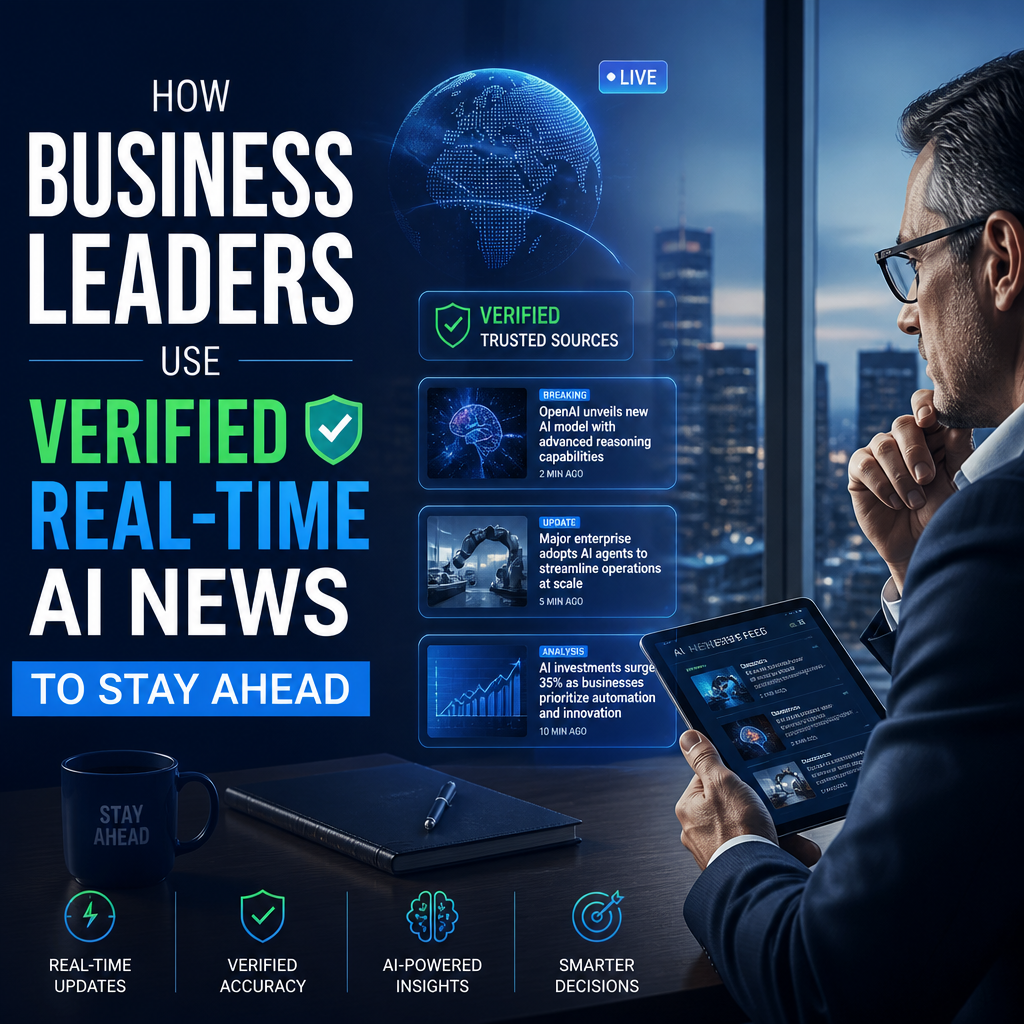
How Business Leaders Use Verified Real-Time AI News to Stay Ahead
How Business Leaders Use Verified Real-Time AI News to Stay Ahead
Business decisions increasingly depend on speed, context, and accuracy. Market conditions can shift within hours, while emerging technologies, regulatory changes, and competitor activity create new opportunities and risks. For this reason, many executives are turning to verified real-time AI news to make better-informed decisions before developments become widely known.
Rather than relying on scattered headlines or unconfirmed social media posts, leaders use intelligent news platforms to monitor important events, validate information, and identify meaningful trends.

Turning Information Into a Competitive Advantage
Traditional news monitoring often requires teams to search across websites, newsletters, industry publications, and public databases. This process can be time-consuming and may still miss critical updates.
AI-powered news tools streamline that work by collecting information from multiple sources and organizing it around specific business interests. Leaders can monitor:

- Competitor announcements
- Industry and market trends
- Regulatory developments
- Investment activity
- Supply chain disruptions
- Consumer sentiment
- Emerging technologies
- Changes in customer behavior
The advantage is not simply receiving more information. It is receiving relevant information quickly enough to act on it.
Why Verification Matters
Speed is valuable, but inaccurate information can lead to costly decisions. Rumors, misleading headlines, outdated reports, and manipulated content can spread rapidly online. Business leaders therefore need news systems that place verification at the center of the process.

Verified real-time AI news can help by comparing reports across credible sources, identifying conflicting claims, and distinguishing confirmed facts from speculation. Some platforms also provide source links, publication times, author details, and summaries of how a story has developed.
This additional context allows executives to evaluate information instead of reacting impulsively. A verified update about a new regulation, for example, can support a coordinated legal, financial, and operational response. An unverified rumor may only create unnecessary confusion.
Improving Executive Decision-Making
Senior leaders often make decisions under pressure and with incomplete information. AI news platforms can reduce that uncertainty by summarizing complex developments in a concise, actionable format.
Faster Briefings
Instead of reading dozens of articles, executives can review personalized briefings covering the topics most relevant to their organization. AI can highlight major developments, explain why they matter, and identify changes since the previous update.
This helps leaders prepare for meetings, board discussions, investor calls, and crisis situations without spending hours gathering background information.
Stronger Strategic Planning
Real-time intelligence also supports long-term planning. Repeated news patterns can reveal where an industry is heading. For example, growing investment in automation, frequent changes in data privacy rules, or increasing demand for sustainable products may signal the need to adjust a company’s strategy.
By tracking these developments over time, leaders can move from reacting to events to anticipating them.
Supporting Risk Management
Business risk rarely comes from a single headline. It often develops through a series of smaller signals. A supplier may face financial difficulties, a government may begin discussing new restrictions, or customer complaints may start appearing across multiple platforms.
AI systems can connect these signals and alert decision-makers when several developments point toward a larger concern. This supports earlier action, such as finding alternative suppliers, reviewing compliance procedures, or adjusting public communications.
Verified information is particularly important during a crisis. Leaders need a reliable view of what has happened, what remains uncertain, and which sources can be trusted.
Helping Teams Work From the Same Facts
Organizations often lose time when departments rely on different information. Marketing may respond to one report, operations may follow another, and legal teams may be working from outdated details.
A shared, AI-supported news system creates a common information base. Teams can access the same verified sources, summaries, timelines, and alerts. This improves communication and makes cross-functional decision-making more consistent.
It can also reduce duplicated research, allowing employees to focus on analysis and execution rather than repeatedly searching for basic facts.
Using AI Without Replacing Human Judgment
Although AI can collect, summarize, and organize information, it should not replace human judgment. Leaders still need to consider business goals, ethical implications, organizational values, and information that may not be visible in public reporting.
The most effective approach combines machine speed with human evaluation. AI identifies relevant developments and patterns, while experienced professionals determine what those developments mean for the organization.
Staying Ahead With Better Intelligence
In competitive markets, being first is not always enough. Businesses must be first with information they can trust. Verified real-time AI news gives leaders a practical way to monitor change, reduce uncertainty, and recognize opportunities earlier.
When integrated into daily workflows, it becomes more than a news service. It becomes a decision-support tool—helping executives understand the present, prepare for the next development, and lead with greater confidence.