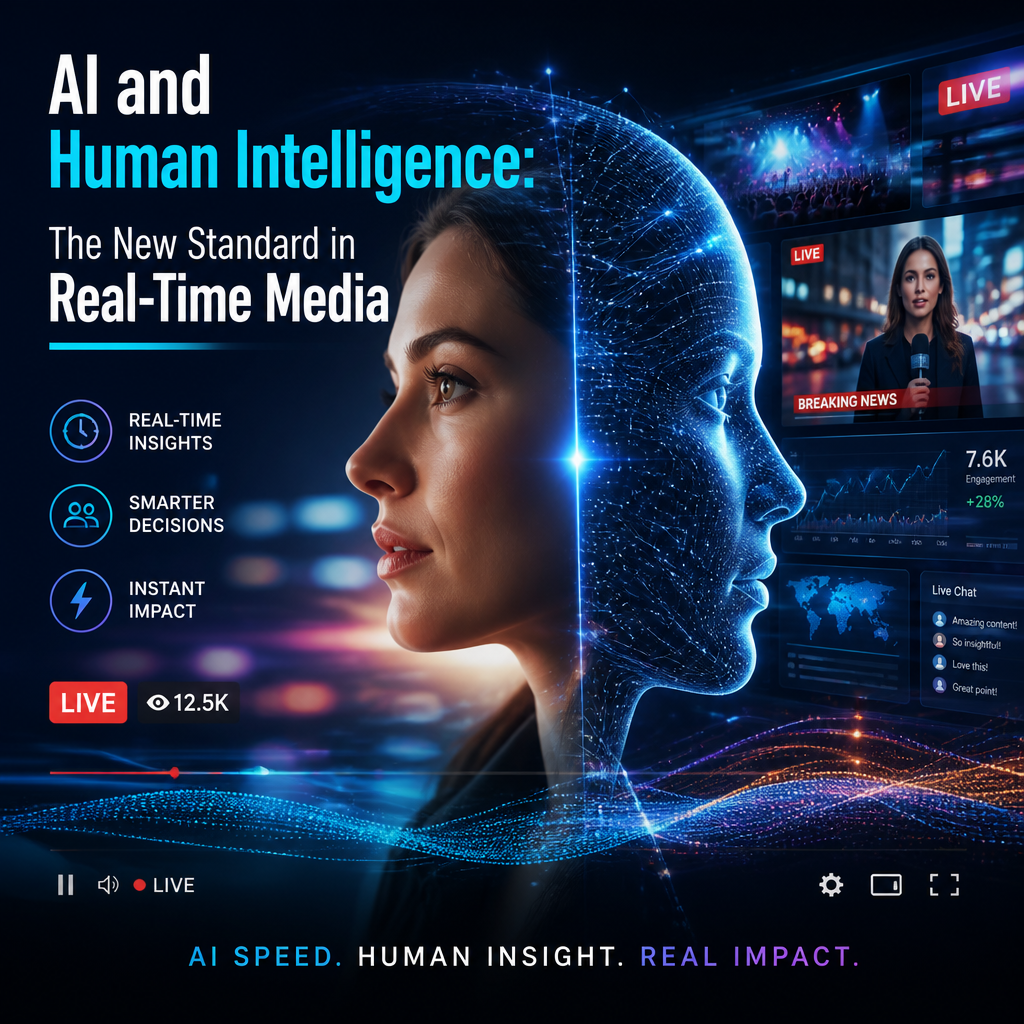
AI and Human Intelligence: The New Standard in Real-Time Media
The Evolution of Real-Time Media: Why AI + Human Intelligence Is the New Standard
Real-time media has changed dramatically in just a few years. Audiences no longer wait for the next morning’s newspaper, evening broadcast, or weekly magazine to understand what is happening. News, entertainment, sports, and social conversations unfold continuously across digital platforms.
This shift has created both opportunity and pressure for media organizations. They must publish faster, personalize content, and respond to audiences in the moment. Yet speed alone is not enough. Accuracy, context, trust, and emotional intelligence remain essential.

That is why the future of media is increasingly defined by a powerful combination: artificial intelligence and human intelligence.
From Scheduled Publishing to Continuous Coverage
Traditional media operated around fixed production cycles. Reporters gathered information, editors reviewed it, and publishers released a finished product at a scheduled time. Digital platforms disrupted that model by making publishing instantaneous and continuous.

Today, real-time media includes:
- Live blogs and breaking news alerts
- Streaming video and audio
- Social media updates
- Personalized content feeds
- Interactive sports and event coverage
- Audience reactions and user-generated content
Readers expect information to be available immediately and updated as events develop. They also expect content to be relevant to their interests, location, and preferred format.

Meeting these expectations manually can be difficult. Newsrooms and media teams must monitor multiple sources, identify important developments, verify details, create content, and distribute it across several channels—often within minutes.
What AI Brings to Real-Time Media
Artificial intelligence has become an important tool for handling the scale and speed of modern media. AI systems can process enormous amounts of information far more quickly than human teams alone.
Faster Information Processing
AI can scan social posts, public records, video transcripts, reports, and other data sources to identify emerging topics. It can detect patterns, flag unusual activity, and help teams recognize which developments may require attention.
Efficient Content Production
AI can assist with tasks such as:
- Transcribing interviews and live events
- Summarizing lengthy reports
- Creating headlines and social posts
- Translating content into multiple languages
- Generating captions and accessibility features
- Updating structured information in real time
These capabilities allow journalists and editors to spend less time on repetitive work and more time on reporting, analysis, and storytelling.
Personalized Experiences
AI can also help deliver the right content to the right audience. Recommendation systems analyze reading behavior, viewing habits, and engagement patterns to create more relevant experiences.
For audiences, this can mean faster access to the topics they care about. For publishers, it can improve engagement while helping them understand how content is being consumed.
Why Human Intelligence Still Matters
Despite its capabilities, AI cannot replace the judgment and responsibility of experienced media professionals.
Real-time information is often incomplete, contradictory, or emotionally charged. An algorithm may identify a trending claim, but it cannot always determine whether that claim is credible, significant, or ethically appropriate to publish.
Human intelligence provides essential qualities, including:
- Editorial judgment
- Source evaluation
- Cultural understanding
- Ethical decision-making
- Emotional sensitivity
- Investigative curiosity
- Accountability
A human editor can recognize when a story needs more context, when a headline is misleading, or when publishing certain details could cause unnecessary harm. These decisions require more than pattern recognition. They require experience, values, and an understanding of consequences.
The Best Model Is Collaboration
The most effective approach is not AI versus humans. It is AI working alongside humans.
In this model, AI handles speed, scale, organization, and repetitive tasks. Human professionals provide verification, interpretation, creativity, and oversight. Each strengthens the other.
A collaborative workflow might look like this:
- AI monitors multiple sources and identifies potential developments.
- Journalists verify facts and contact relevant sources.
- AI helps prepare transcripts, summaries, or initial drafts.
- Editors add context, clarity, and human perspective.
- Automated tools distribute content across appropriate platforms.
- Human teams continue monitoring updates and corrections.
This approach makes real-time media more efficient without sacrificing credibility.
Building Trust in an Instant Media Environment
Speed can create risk. The pressure to publish first may encourage speculation, amplify misinformation, or remove important context. As a result, trust has become one of the most valuable assets in media.
Organizations using AI must be transparent about how it is applied. They should establish clear standards for:
- Fact-checking AI-assisted content
- Protecting personal data
- Identifying synthetic media
- Correcting errors quickly
- Maintaining editorial accountability
Audiences may accept automation, but they still expect responsible communication. Trust depends on knowing that someone is ultimately reviewing, questioning, and standing behind the information being shared.
The Future of Real-Time Media
The evolution of real-time media is not simply a story about faster technology. It is a shift toward more responsive, intelligent, and interactive communication.
AI will continue improving how media organizations discover, produce, personalize, and distribute content. Human professionals will remain essential for deciding what matters, what is true, and how stories should be told.
The new standard is therefore a partnership. When artificial intelligence provides speed and human intelligence provides judgment, media can become both more immediate and more meaningful.