
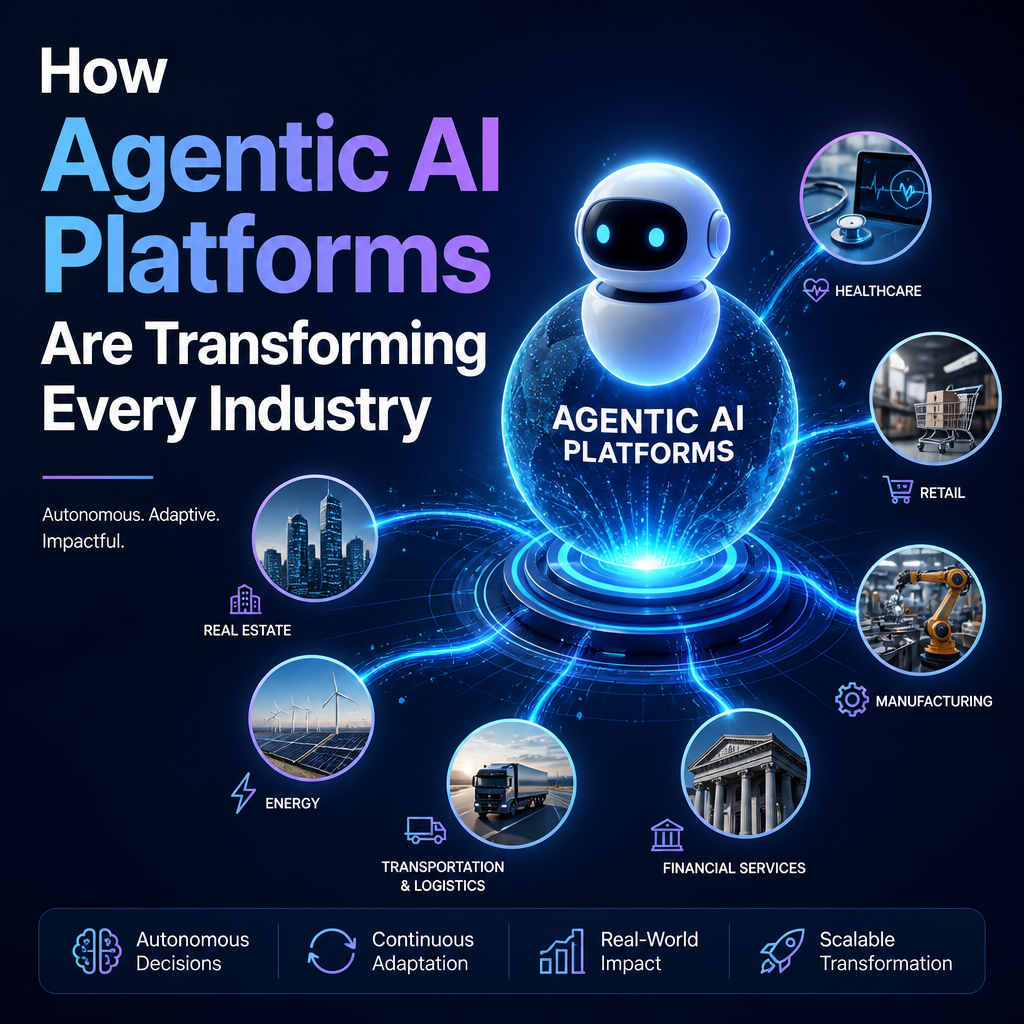
How Agentic AI Platforms Are Transforming Every Industry
How Agentic AI Platforms Are Transforming Every Industry
Artificial intelligence is moving beyond tools that simply answer questions or generate content. The rise of agentic AI platforms is introducing systems that can understand goals, make decisions, coordinate tasks, and take action with limited human supervision.
Unlike traditional software, which follows fixed instructions, agentic AI can adapt to changing conditions. This shift is transforming how organizations operate, serve customers, manage resources, and innovate.

What Are Agentic AI Platforms?
Agentic AI platforms provide the infrastructure for building and managing intelligent AI agents. These agents can:
- Interpret natural-language goals
- Plan multi-step workflows
- Use business applications and databases
- Collaborate with other agents or employees
- Learn from feedback and changing circumstances
- Take actions based on rules, context, and permissions
For example, a customer service agent might identify a customer’s issue, review their account history, issue a refund within approved limits, and escalate unusual cases to a human representative.

The key difference is autonomy. Generative AI creates an output when prompted, while agentic AI can pursue an objective across multiple steps.
Transforming Business Operations
One of the most immediate benefits of agentic AI platforms is the automation of complex business processes. Many workflows involve repetitive decisions across multiple systems, such as processing invoices, updating customer records, or reviewing applications.

AI agents can connect these systems and complete tasks from beginning to end. This reduces manual data entry, shortens processing times, and helps employees focus on work that requires creativity, judgment, and relationship-building.
Organizations can also use agents to monitor operations continuously. An agent may detect a supply shortage, compare alternative suppliers, recommend a response, and notify the appropriate team before the issue affects production.
Reshaping Customer Experience
Customer expectations are rising across nearly every sector. People want fast, personalized, and consistent support at any time of day.
Agentic AI platforms enable customer service systems to move beyond scripted chatbots. Intelligent agents can understand context, remember previous interactions, and resolve issues across channels. They may schedule appointments, track orders, troubleshoot products, or coordinate returns without requiring customers to repeat information.
Human employees remain essential for sensitive or complicated situations. However, AI agents can handle routine requests and provide representatives with relevant information, enabling faster and more effective service.
Advancing Healthcare
Healthcare organizations face pressure from rising demand, administrative complexity, and workforce shortages. Agentic AI can support both clinical and operational tasks.
Potential applications include:
- Scheduling and rescheduling appointments
- Summarizing medical records
- Coordinating referrals
- Monitoring patient follow-up needs
- Supporting insurance and billing workflows
- Helping clinicians identify relevant research
These systems do not replace medical professionals. Instead, they reduce administrative burdens and help practitioners spend more time with patients. Because healthcare involves sensitive information and high-stakes decisions, strong privacy controls, human oversight, and regulatory compliance are essential.
Increasing Productivity in Finance
Financial institutions are using AI agents to improve fraud detection, risk analysis, compliance, and customer support. An agent can review large volumes of transactions, identify unusual patterns, and prepare a case for human investigators.
In commercial banking, agents may help businesses analyze cash flow, forecast financial needs, or manage routine account services. Investment and insurance companies can also use agentic systems to summarize market information, compare scenarios, and support internal research.
The greatest value often comes from combining automation with expert review. Agents can process information at scale, while financial professionals provide judgment and accountability.
Improving Manufacturing and Supply Chains
Manufacturing depends on precise coordination among equipment, workers, suppliers, and distributors. Agentic AI platforms can help organizations respond to disruptions and improve efficiency.
AI agents may monitor machinery for signs of failure, recommend maintenance, adjust production schedules, or identify alternatives when a supplier cannot deliver materials. In warehouses, agents can optimize inventory levels and coordinate fulfillment activities.
By connecting operational data with planning systems, agentic AI can help companies become more responsive and resilient.
Changing Education and Public Services
Schools and universities can use AI agents to provide personalized learning support, answer administrative questions, and help educators organize course materials. Students may receive tutoring that adapts to their strengths and weaknesses, while teachers gain assistance with feedback and lesson planning.
Government agencies can use similar systems to simplify applications, guide residents through complex services, and improve internal case management. Carefully designed AI agents can make public services more accessible while reducing administrative delays.
Building Responsible AI Systems
The expansion of agentic AI also introduces important risks. Autonomous systems can make incorrect decisions, misuse access, or produce outcomes that are difficult to explain.
Organizations should establish:
- Clear limits on what agents can do
- Permission-based access to data and tools
- Human approval for high-impact actions
- Detailed activity logs and audit trails
- Continuous testing and performance monitoring
- Strong privacy and cybersecurity protections
Successful adoption requires more than deploying advanced technology. Companies must redesign processes, train employees, and create governance policies that balance autonomy with accountability.
The Future of Agentic AI
Agentic AI platforms are becoming a new layer of digital infrastructure. They can connect people, data, and software in ways that make organizations more adaptive and efficient.
The companies most likely to benefit will not be those that automate everything without oversight. They will be the ones that identify meaningful use cases, establish responsible controls, and combine machine intelligence with human expertise.
As these platforms mature, AI agents will increasingly work alongside employees across every industry. The result will be faster operations, more personalized services, and new opportunities for innovation.