Why Algorithmic News Curation Fails Without Human Context
Why Algorithmic News Curation Fails Without Human Context
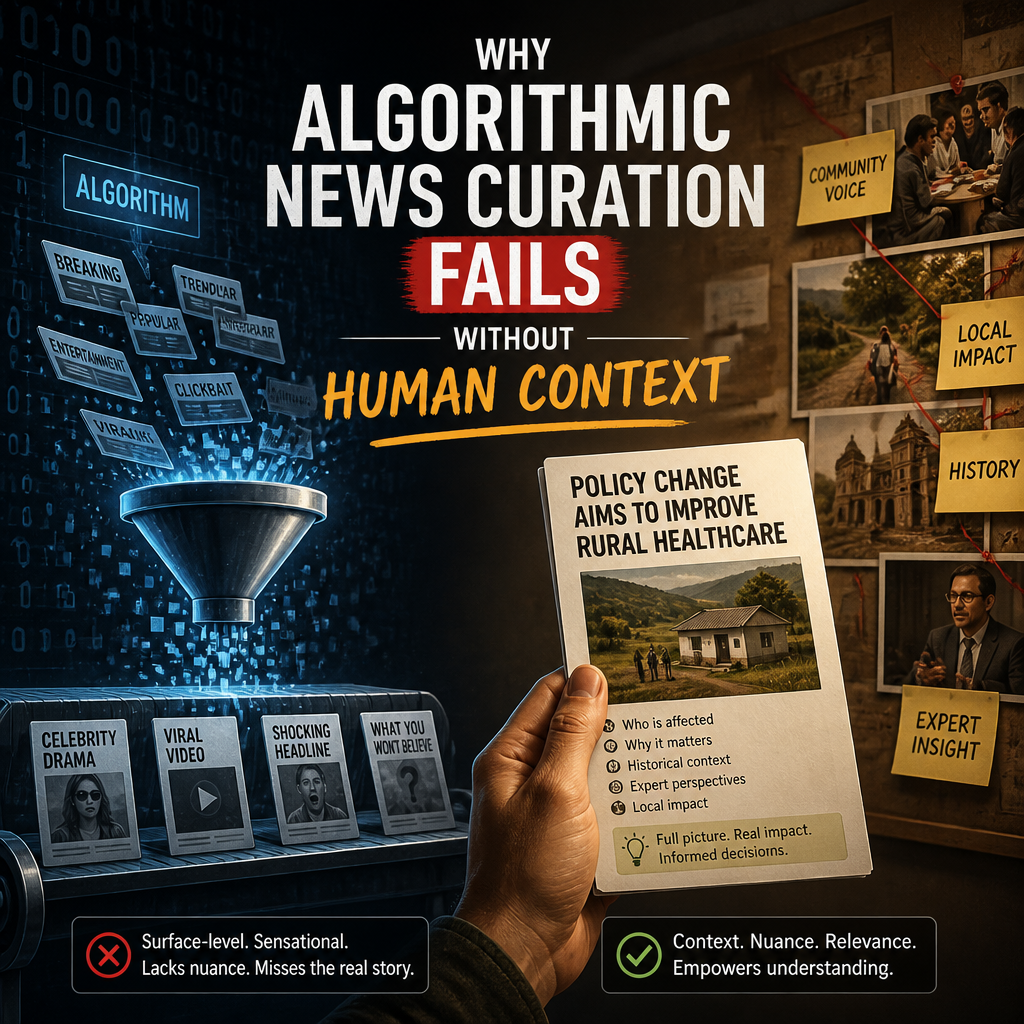
Every day, algorithms sort through millions of headlines, videos, posts, and updates to decide what deserves our attention. Their speed and scale are impressive, but speed alone does not create understanding. Without human context, algorithmic news curation can turn information into confusion, amplify misleading narratives, and leave audiences less informed than before.
Algorithms are excellent at detecting patterns. They can identify popular topics, recommend stories based on past behavior, and deliver updates almost instantly. What they cannot reliably do is explain why a story matters, what came before it, or how competing claims should be evaluated.

Algorithms See Signals, Not Meaning
Most news algorithms rely on measurable signals, such as clicks, shares, viewing time, and search activity. These signals help platforms predict what users may engage with. However, engagement is not the same as importance or accuracy.
A sensational headline may attract more clicks than a carefully reported investigation. An emotional post may spread faster than a nuanced explanation. When systems prioritize activity above all else, they can reward content that provokes outrage, fear, or curiosity—even when it offers little public value.

This creates a fundamental problem: algorithms often interpret popularity as relevance. A story may be widely shared because it is useful, but it may also be spreading because it is misleading, divisive, or emotionally manipulative.
Context Is More Than Additional Information
Human context does not simply mean adding more facts. It means helping readers understand relationships between facts.

Consider a breaking news report about an economic downturn. An algorithm might recommend the latest market figures, reactions from prominent accounts, and related headlines. A human editor, however, may also explain:
- How the figures compare with historical trends
- Whether the change is temporary or part of a longer pattern
- Which sources produced the data
- Who is most affected
- What remains uncertain
That interpretive layer allows people to distinguish a significant development from a dramatic but less meaningful update. Without it, audiences may mistake isolated events for major trends or confident speculation for established evidence.
Personalization Can Narrow Perspective
Personalized news feeds are designed to make information feel relevant. Yet excessive personalization can create an information environment shaped primarily by existing interests and assumptions.
When users are repeatedly shown stories similar to those they have already read, they may encounter fewer unfamiliar perspectives. Over time, this can produce filter bubbles in which certain facts, arguments, or communities appear invisible. The algorithm may be accurately predicting what a person will click while failing to expose them to what they need to understand.
Human editors can challenge this pattern by introducing important but less popular viewpoints, correcting common misunderstandings, and placing local events within broader national or global contexts. Good curation is not merely about giving people more of what they prefer. It is also about helping them discover what they may have overlooked.
Breaking News Requires Judgment
During fast-moving events, information changes rapidly. Early reports may be incomplete, contradictory, or wrong. Algorithms can distribute an unverified claim at enormous speed, especially when that claim generates strong engagement.
Human journalists and editors contribute judgment during these moments. They assess source credibility, distinguish confirmed facts from claims, and communicate uncertainty clearly. Phrases such as “officials have not verified this report” or “the available evidence remains limited” are not signs of weakness. They are essential signals that help readers interpret developing stories responsibly.
Without such judgment, algorithmic curation can make rumors look authoritative simply because they are widespread.
Human Oversight Improves Algorithmic Systems
The solution is not to eliminate algorithms. They are valuable tools for organizing vast quantities of information and helping audiences find relevant reporting. The problem arises when automated systems operate without meaningful editorial oversight.
A stronger approach combines machine efficiency with human responsibility. News organizations and platforms can:
- Use algorithms to identify emerging topics and potential connections.
- Apply editorial review to assess accuracy, significance, and fairness.
- Label developing, disputed, or opinion-based content clearly.
- Include diverse sources and perspectives.
- Audit recommendation systems for bias and harmful incentives.
This model recognizes that technology can assist with discovery, but people must remain responsible for interpretation.
Information Needs Interpretation
The central weakness of algorithmic news curation is not that algorithms lack intelligence. It is that they are built to optimize measurable behavior, while journalism serves broader human goals: accuracy, understanding, accountability, and informed citizenship.
A headline is not a complete story. A trend is not necessarily a truth. And high engagement is not proof of public importance.
Human context transforms scattered updates into meaningful knowledge. As news systems become more automated, the most valuable role for editors, reporters, and thoughtful curators may be helping audiences understand not only what is happening, but why it matters—and what they should reasonably believe about it.