
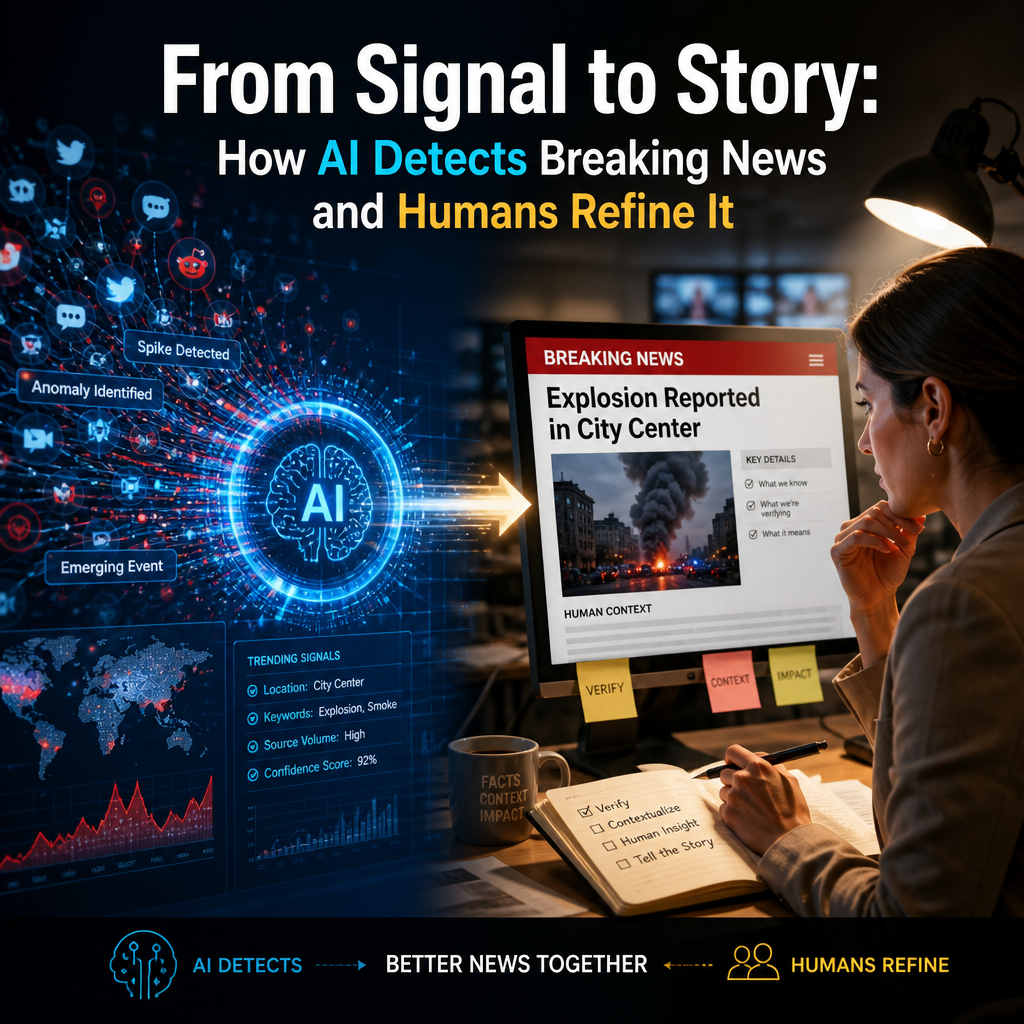
From Signal to Story: How AI Detects Breaking News and Humans Refine It
From Signal to Story: How Our AI Detects Breaking News and Humans Refine It
Breaking news rarely arrives as a polished article. It begins as a signal: a social media post, an official statement, a sudden change in public data, or a report from someone close to an unfolding event.
Our approach combines artificial intelligence with human judgment to turn those early signals into clear, trustworthy stories. AI helps us spot what matters quickly. Editors and reporters provide the context, verification, and nuance that readers need.

Finding the First Signal
News can emerge anywhere and at any time. Monitoring every relevant source manually is impossible, especially during fast-moving events. AI helps by continuously scanning large volumes of information, including:
- News websites and press releases
- Government and public agency updates
- Social media posts
- Company announcements
- Public records and data feeds
- Local and specialized publications
The system looks for unusual activity, repeated mentions, sudden changes, and connections between seemingly unrelated updates. A single post may not be meaningful on its own, but several independent signals appearing at once can indicate that a significant event is developing.

This process is not about allowing algorithms to decide what is news. It is about giving journalists an efficient way to discover potential stories before they become widely visible.
Separating Developments from Noise
The internet produces an enormous amount of information, but not all information is useful or reliable. AI can help organize incoming material by identifying patterns and ranking possible story leads.

For example, it may detect:
- A sharp increase in discussion around a specific event
- Similar reports from multiple locations
- New language in an official document
- A developing disruption to transportation or public services
- Statements that contradict previous information
These alerts give editors a starting point. They do not automatically become headlines. Every signal must be assessed for relevance, accuracy, and public importance.
Human Verification Comes First
Speed matters in breaking news, but accuracy matters more. Once AI flags a potential story, human journalists investigate it.
They ask essential questions:
- What exactly happened?
- Who is reporting it?
- Can the information be independently confirmed?
- What evidence supports the claim?
- What remains unknown?
- Could publishing the information cause unnecessary harm?
Reporters may contact officials, review original documents, compare accounts, and examine eyewitness material. Editors also consider whether a source has a history of accuracy and whether a claim is being repeated without independent confirmation.
AI can identify a possible event. It cannot replace responsibility for determining whether that event should be reported as fact.
Turning Facts into Context
A breaking update may answer what happened, but readers also need to understand why it matters. This is where human editorial work becomes especially important.
Journalists place new information in context by connecting it to:
- Previous developments
- Relevant laws, policies, or history
- Communities affected by the event
- Available statistics and expert analysis
- Statements from different sides
- What authorities or organizations have not yet confirmed
Context prevents isolated claims from becoming misleading narratives. It also helps readers distinguish between an initial report, a confirmed development, and a broader trend.
Writing Clearly Under Pressure
Breaking news often changes by the minute. Early coverage must therefore be precise without pretending to know more than is currently available.
Editors refine language to make uncertainty clear. Phrases such as “according to,” “officials said,” and “the situation remains under investigation” are not empty qualifications. They tell readers how information was obtained and how confident they should be.
Stories are updated as new facts emerge. Corrections are made openly when necessary. Headlines may change when the facts change. This ongoing process reflects a central principle of responsible journalism: a story is not finished simply because it has been published.
AI as a Tool, Not the Author
Our AI systems are designed to support journalists, not replace them. They can monitor sources, identify patterns, summarize large collections of material, and highlight information that deserves attention.
Humans remain responsible for:
- Verification
- Source evaluation
- Interviews
- Ethical decisions
- Editorial judgment
- Final publication
The result is a partnership between machine speed and human reasoning. AI helps reduce the time between an event and its discovery. Journalists ensure that the final story is accurate, fair, understandable, and useful.
From Signal to Story
The journey from signal to story is not a single automated step. It is a careful process of detection, verification, reporting, editing, and updating.
Technology helps us see the first signs of a developing event. Human journalists transform those signs into reporting that readers can trust. Together, these tools and skills make it possible to respond quickly while preserving the standards that give news its value.