Why Purely Automated News Outlets Fail and Human-AI Models Win
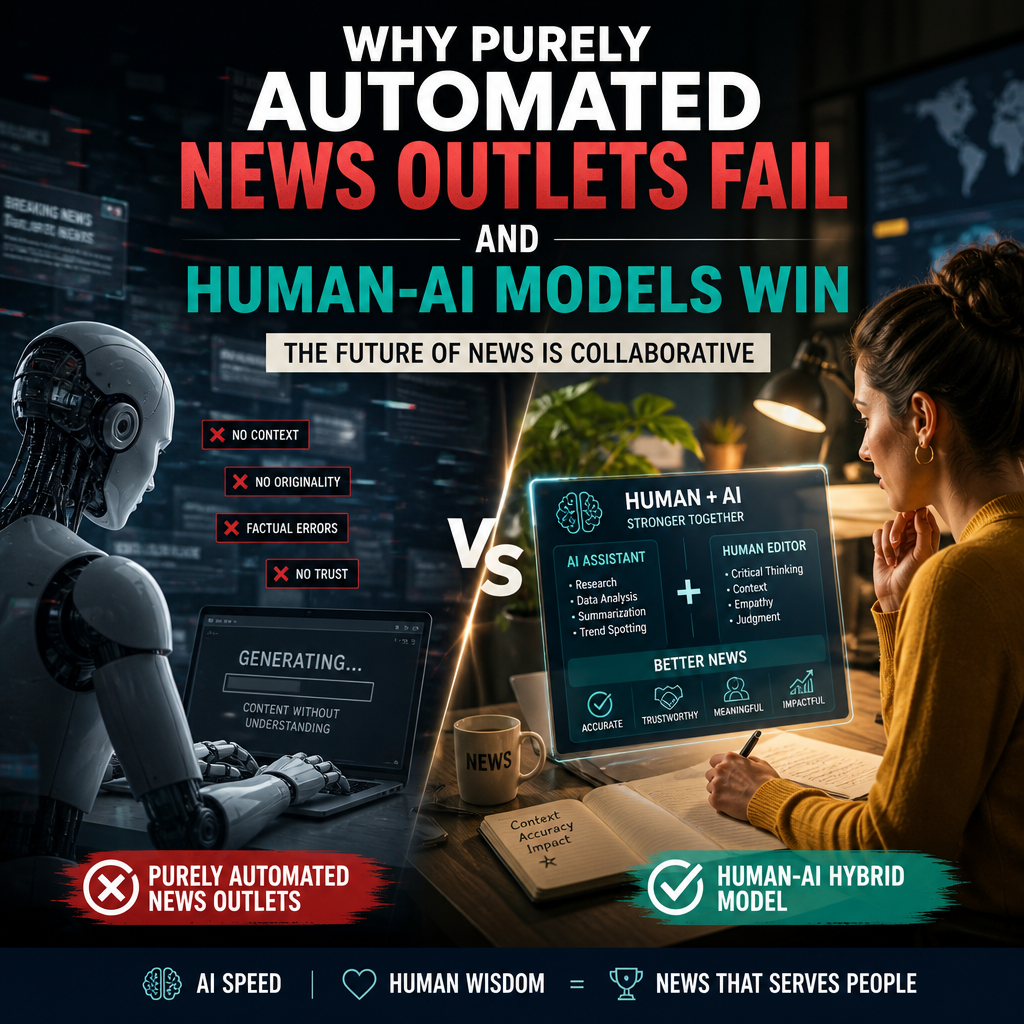
Why Purely Automated News Outlets Fail—and How Human-AI Hybrid Models Win
Automation has transformed the news industry. Artificial intelligence can scan thousands of documents, summarize breaking events, translate reports, and publish updates within seconds. For publishers under pressure to produce more content with fewer resources, fully automated news outlets may seem like the logical next step.
Yet speed and volume do not guarantee journalism readers can trust. Purely automated news operations often struggle with accuracy, context, originality, and accountability. The strongest future for digital publishing is not human versus machine. It is a human-AI hybrid model that combines technological efficiency with editorial judgment.

The Limits of Pure Automation
Speed Can Amplify Errors
AI systems are designed to recognize patterns and generate likely sequences of words. They do not automatically understand whether a source is credible, whether a statement is misleading, or whether a developing story has been misinterpreted.
When an automated system pulls information from incomplete reports, it may present speculation as fact. A minor data error can quickly become a published headline, copied across social platforms, and repeated by other outlets. Automation makes distribution faster, but it can also make correction more difficult.

Context Is Hard to Automate
News is rarely just a collection of facts. Readers need to understand why an event matters, what led to it, and how it affects different communities.
An algorithm can summarize a government announcement, but it may miss important context about previous policies or local consequences. It may quote a public figure without recognizing sarcasm, political messaging, or a conflict of interest. Human journalists contribute the background knowledge and critical thinking needed to turn raw information into meaningful reporting.

Originality Suffers
Purely automated outlets often produce content that sounds similar from one article to the next. Even when the writing is grammatically polished, it may lack a distinct voice, strong reporting, or a compelling perspective.
This creates a serious problem in a crowded media environment. Search engines and readers increasingly reward content that offers original insight, firsthand evidence, expert analysis, or clear value. Articles generated by recycling existing reports may struggle to build loyalty because they give audiences little reason to return.
Accountability Cannot Be Automated
Journalism involves responsibility. Editors must decide whether a story is sufficiently verified, whether a source should be protected, and whether publishing certain details could cause harm.
An AI system cannot meaningfully accept responsibility for a damaging claim. It cannot explain its editorial reasoning to a grieving family or defend a difficult decision in the public interest. Human oversight remains essential wherever accuracy, fairness, privacy, and ethics are involved.
How Human-AI Hybrid Models Work
A human-AI hybrid newsroom assigns different tasks to people and technology based on their strengths.
AI can assist with:
- Monitoring breaking news and public records
- Identifying emerging trends
- Transcribing interviews
- Translating documents
- Generating initial summaries
- Checking spelling, grammar, and formatting
- Organizing large datasets
Journalists and editors remain responsible for:
- Verifying facts and sources
- Conducting interviews
- Adding context and analysis
- Making ethical decisions
- Setting editorial priorities
- Reviewing headlines and final copy
- Correcting mistakes transparently
This division of labor allows newsrooms to work faster without treating automation as a substitute for judgment.
Why the Hybrid Model Performs Better
Efficiency Without Sacrificing Trust
AI can reduce the time spent on repetitive tasks, giving journalists more capacity for investigation and original reporting. A reporter might use an AI tool to search thousands of financial records, then focus human effort on interpreting the findings and speaking with affected people.
The result is more efficient journalism that still reflects professional standards.
Better Coverage
Smaller newsrooms often lack the resources to monitor every meeting, report, or data release. AI tools can help identify stories that might otherwise be overlooked. Editors can then determine which leads deserve deeper reporting.
This expands coverage while preserving a human editorial filter.
Stronger Reader Relationships
Audiences are more likely to trust outlets that clearly explain how their reporting was produced. A newsroom that uses AI responsibly can disclose when automation assisted with transcription, data analysis, or drafting while emphasizing that humans reviewed the final work.
Transparency helps readers understand that technology supports the journalism rather than replacing it.
Building a Responsible Hybrid Newsroom
A successful model requires more than adding an AI tool to an existing workflow. News organizations should establish clear standards, including:
- Mandatory human review: No sensitive or consequential story should be published without qualified editorial approval.
- Source verification: AI-generated claims must be checked against reliable primary or independent sources.
- Disclosure policies: Readers should know when automation significantly contributes to an article.
- Bias testing: Tools should be evaluated for patterns that may exclude, misrepresent, or unfairly target communities.
- Correction procedures: Errors should be corrected quickly and visibly, regardless of whether a human or AI system introduced them.
The Future of News Is Collaborative
The failure of purely automated news outlets does not mean AI has no place in journalism. It means technology works best when paired with expertise, skepticism, and accountability.
Human-AI hybrid models can help newsrooms publish faster, investigate more deeply, and serve audiences more effectively. But the essential value of journalism remains human: asking difficult questions, recognizing nuance, understanding consequences, and choosing truth over convenience.
The future will not belong to outlets that automate everything. It will belong to those that use automation thoughtfully while keeping human judgment at the center of the newsroom.