
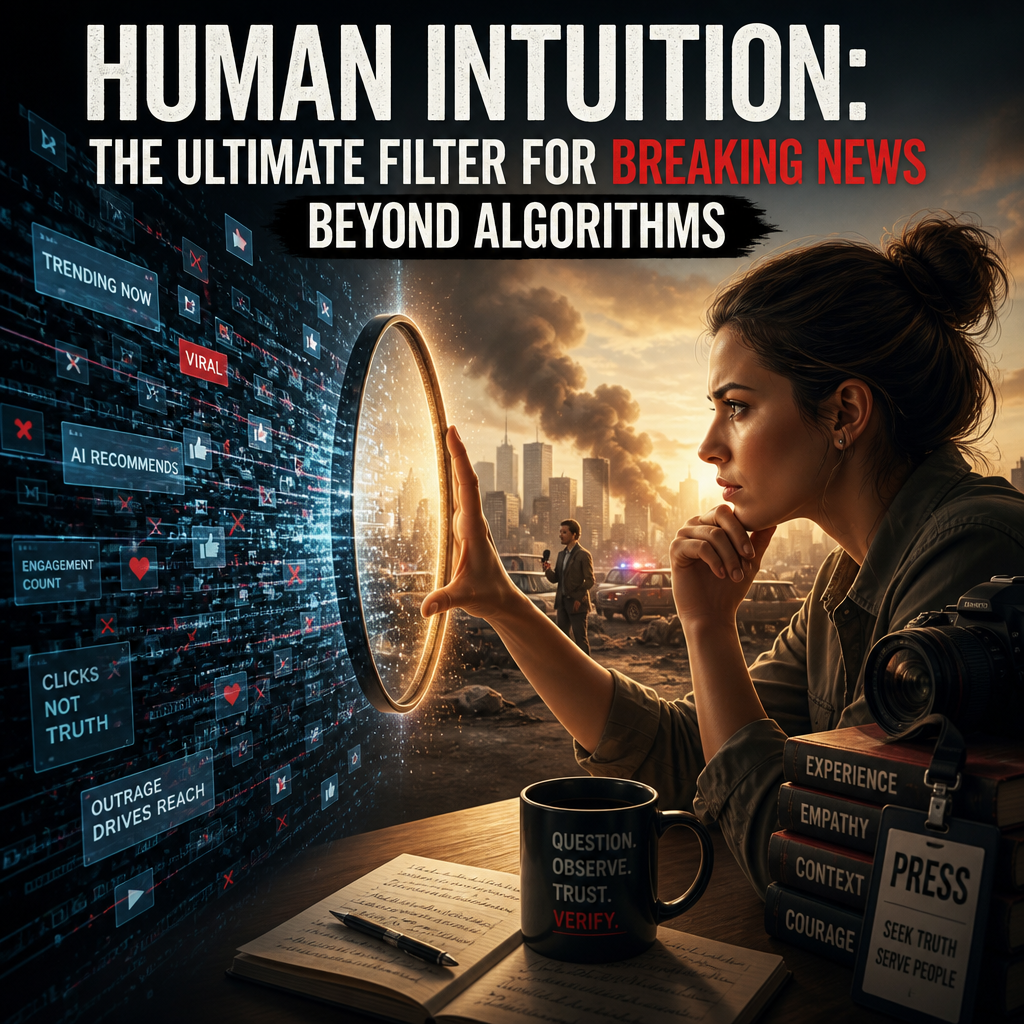
Human Intuition: The Ultimate Filter for Breaking News Beyond Algorithms
Beyond Algorithms: Why Human Intuition Remains the Ultimate Filter for Breaking News
Breaking news now moves at extraordinary speed. A single post, video, or alert can reach millions of people before journalists have confirmed what happened. Algorithms help sort this flood of information, identifying keywords, tracking trends, and distributing updates to audiences worldwide.
Yet speed is not the same as accuracy. In the most important moments, human intuition remains essential for separating meaningful facts from misleading signals. Technology can process information at scale, but people still provide the judgment, context, and ethical awareness that responsible journalism requires.

The Limits of Algorithmic News
Algorithms are designed to recognize patterns. They can detect unusual activity, compare claims against databases, and flag content that resembles previously identified misinformation. These capabilities are valuable, especially when newsrooms are dealing with thousands of posts every minute.
However, algorithms do not truly understand events. They analyze data based on programmed rules and historical examples. When a situation is unfamiliar, ambiguous, or rapidly changing, automated systems may struggle to interpret what they see.

For example, an old photograph may suddenly circulate as evidence of a current disaster. An algorithm can identify the image and measure its popularity, but it may not recognize the emotional manipulation behind its use. A journalist, on the other hand, can question the image’s origin, contact sources, and consider why it is resurfacing now.
Context Cannot Be Fully Automated
Breaking news rarely arrives as a complete story. Initial reports are often partial, contradictory, or shaped by the perspectives of those closest to an event. Understanding what matters requires more than collecting facts; it requires context.

Human journalists bring knowledge of:
- Local politics and social tensions
- Historical conflicts and ongoing disputes
- Cultural language and implied meaning
- The reliability of specific sources
- The difference between an isolated incident and a wider trend
This background helps journalists recognize when a seemingly minor detail may be significant—or when a dramatic claim lacks substance. Algorithms can rank information by engagement, but engagement does not necessarily reflect public importance.
A sensational rumor may generate millions of views, while a quiet official document may contain the most reliable evidence. Human judgment helps prevent popularity from becoming a substitute for relevance.
Intuition Is Pattern Recognition with Responsibility
Human intuition is sometimes described as a feeling, but experienced journalists understand that it is usually informed pattern recognition. After years of covering elections, disasters, protests, or public emergencies, reporters develop an instinct for what seems unusual.
They notice inconsistencies in wording, timing, behavior, or source selection. They may sense that a quote is being presented without necessary context or that a video has been edited to create a false impression.
Crucially, professional intuition is not meant to replace verification. It creates the questions that verification must answer. A journalist’s instinct may prompt them to check a timestamp, contact an eyewitness, examine satellite imagery, or seek confirmation from an independent authority.
In this way, intuition functions as an early-warning system. It directs attention toward information that deserves deeper scrutiny.
The Human Role in Ethical Decisions
News decisions are not purely technical. Editors must decide whether publishing a detail could endanger a person, identify a vulnerable source, or intensify public panic. These choices require empathy and an understanding of consequences.
An automated system may recommend publishing a graphic image because it is highly relevant and widely shared. A human editor must consider whether the image informs the public or merely exploits suffering. Similarly, an algorithm may flag a heated statement as harmful without understanding whether it is a credible warning, a political opinion, or a quotation used for critical reporting.
Ethical journalism depends on values that cannot be reduced to engagement metrics. Accuracy, fairness, proportionality, and compassion must guide the final decision.
Building Better Newsrooms
The future of breaking news should not involve choosing between technology and human expertise. It should combine both.
Algorithms can help journalists:
- Monitor vast information networks
- Identify emerging events
- Translate and organize large datasets
- Detect repeated claims and possible contradictions
- Prioritize material for investigation
Journalists, meanwhile, should verify sources, assess context, challenge assumptions, and make ethical judgments. This partnership allows technology to handle scale while people remain responsible for meaning.
News organizations can strengthen this process by training reporters in digital verification, data literacy, and critical thinking. They should also make clear when automated tools are used and maintain editorial oversight at every stage.
Trust Depends on Judgment
Audiences may encounter breaking news through automated feeds, but their long-term trust depends on whether coverage proves accurate and responsible. A fast report that later requires major corrections can damage credibility more than a careful report published a few minutes later.
Human intuition provides the pause that speed often removes. It encourages journalists to ask not only, “Can we publish this?” but also, “What do we know, what do we not know, and how might this affect people?”
In an age of instant information, that discipline is more important than ever. Algorithms can find the signal in a massive stream of data, but human judgment determines whether the signal is real, relevant, and worthy of public trust.