
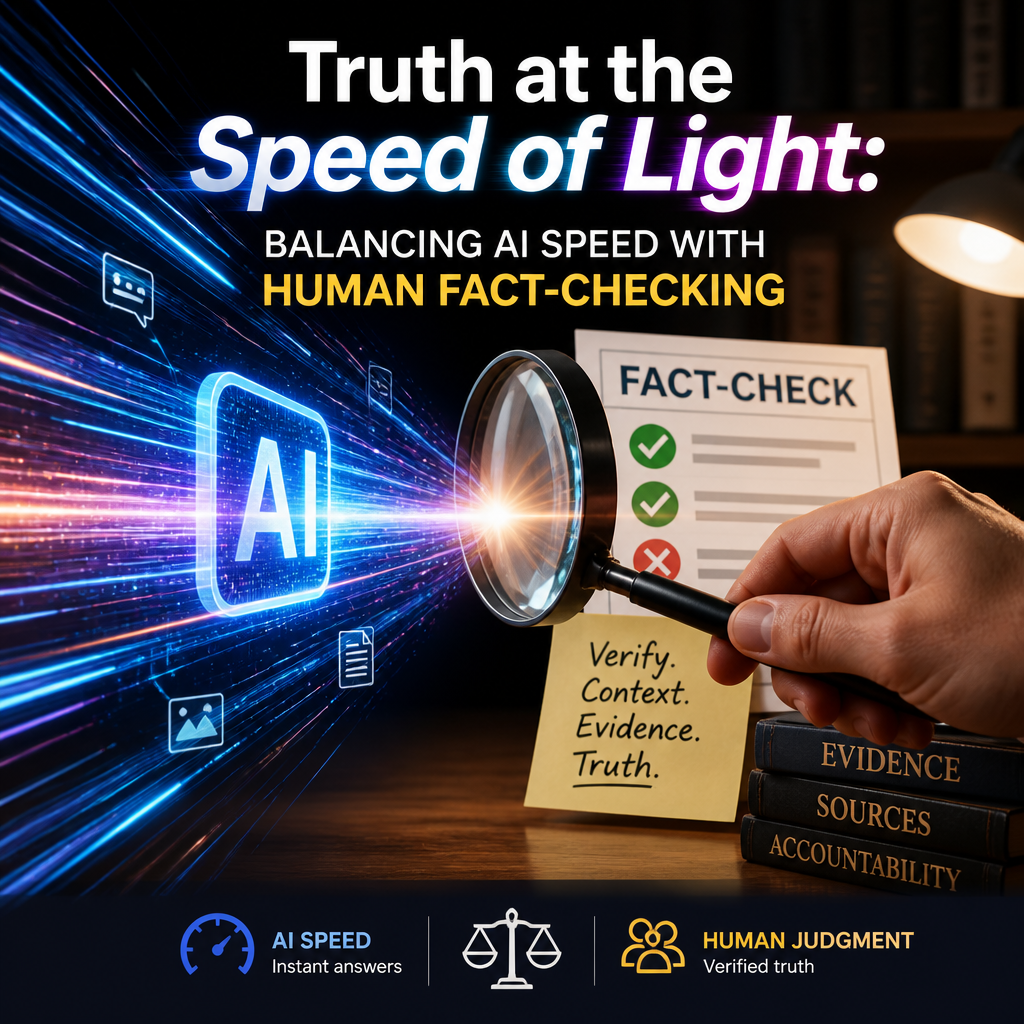
Truth at the Speed of Light: Balancing AI Speed with Human Fact-Checking
Truth at the Speed of Light: Balancing Machine Velocity with Human Fact-Checking
Information now travels almost instantly. A post can reach millions of people before journalists have verified its claims, experts have reviewed the evidence, or readers have had time to reflect. Artificial intelligence and automated publishing tools have accelerated this process even further.
Speed can be useful, especially during emergencies. But when speed becomes the main measure of success, accuracy often suffers. The challenge is not choosing between technology and human judgment. It is learning how to combine both responsibly.

The Rise of Instant Information
Machine systems can collect, summarize, translate, and distribute information in seconds. News organizations use automated tools to monitor events, social platforms recommend breaking stories, and search engines surface developing narratives almost immediately.
This velocity has clear advantages:

- Emergency warnings can spread quickly.
- Important public updates can reach distant communities.
- Data can be analyzed faster than any individual could manage.
- Journalists can identify patterns and potential leads more efficiently.
However, machines do not automatically understand context, intention, or credibility. An algorithm may recognize that a claim is attracting attention without knowing whether the claim is true. It can repeat a widely shared error just as efficiently as a verified fact.
Why Fact-Checking Takes Time
Fact-checking is often slower because it involves careful judgment. A responsible reviewer may need to locate original documents, contact sources, compare independent accounts, and assess the reliability of available evidence.

Some claims are especially difficult to verify. A photograph may be real but taken years earlier. A statistic may be accurate but presented without essential context. A quote may be genuine but edited to change its meaning.
Human fact-checkers also consider questions machines can struggle with:
- Who created the information?
- What evidence supports the claim?
- What might the source gain by promoting it?
- Is the wording designed to provoke an emotional reaction?
- What relevant information has been left out?
These questions do not produce instant answers, but they help protect the public from misleading conclusions.
The Cost of Getting It Wrong
Errors spread faster than corrections. A false headline can be copied across websites, screenshotted, translated, and repeated by people who never encounter the eventual correction. Even when inaccurate information is removed, it may continue influencing opinions and decisions.
The consequences can be serious. Health misinformation may discourage people from seeking treatment. False financial claims can affect investments. Misleading political content can damage trust in elections and public institutions.
Speed also creates pressure on professionals. Reporters may feel compelled to publish before competitors. Social media users may share unverified posts because being first appears more valuable than being right. Over time, this environment can make uncertainty seem like failure, even when caution is appropriate.
A Better Partnership Between Humans and Machines
The solution is not to slow every process to a crawl. Instead, organizations should divide responsibilities according to the strengths of each participant.
Machines are well suited to:
- Monitoring large volumes of information.
- Detecting duplicate claims and unusual patterns.
- Comparing figures across databases.
- Flagging content that requires review.
- Tracking how quickly a story is spreading.
Humans should remain responsible for:
- Evaluating sources and context.
- Interviewing experts and witnesses.
- Recognizing ambiguity and satire.
- Assessing potential harm.
- Making final publication decisions.
This approach allows technology to provide speed without granting it unchecked authority. Automated systems can identify what deserves attention, while human reviewers determine what deserves trust.
Building a Culture of Verification
Readers also have an important role. Before sharing a dramatic claim, people can pause and check several basic details:
- Is the original source identifiable?
- Does the date match the event being described?
- Are reputable independent sources reporting the same information?
- Does the headline accurately reflect the article?
- Is the content appealing mainly to fear, anger, or outrage?
Organizations can support this behavior by labeling developing stories clearly, linking to primary evidence, correcting mistakes visibly, and explaining what remains unknown. Transparency is especially important when facts are still emerging.
Trust Matters More Than Being First
The future of information will be fast, but it should not be careless. Machine velocity can help society respond to events, discover patterns, and distribute useful knowledge. Human fact-checking provides the judgment needed to separate evidence from assumption.
The goal is not truth at any cost or speed at any cost. It is a sustainable balance in which technology accelerates the search for facts while people remain accountable for deciding what can be responsibly believed and shared.
In an age of instant communication, trust is built by showing that accuracy still matters more than being first.