
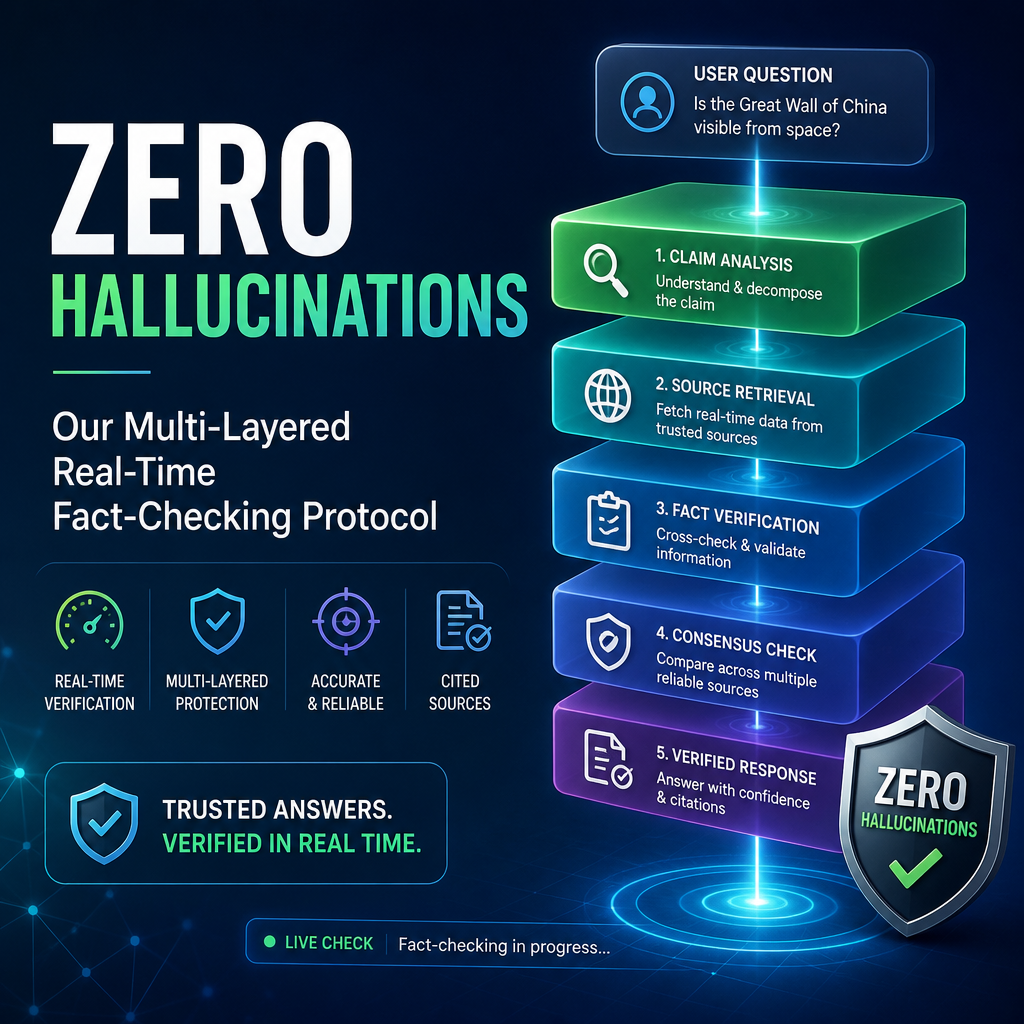
Zero Hallucinations: Our Multi-Layered Real-Time Fact-Checking Protocol
Zero Hallucinations, 100% Real-Time: Our Multi-Layered Fact-Checking Protocol
In an age of instant updates, artificial intelligence, and nonstop information flows, accuracy is more important—and more difficult—than ever. A single incorrect detail can spread rapidly, damage trust, and influence decisions long after the original mistake is forgotten.
That is why we built a multi-layered fact-checking protocol designed to deliver reliable, real-time information while minimizing the risk of hallucinations. Our goal is simple: every answer should be grounded in evidence, clearly sourced, and honest about uncertainty.

Why Real-Time Accuracy Matters
Information changes quickly. News develops by the minute, product specifications are updated, regulations evolve, and public data can become outdated without warning. Static knowledge alone is not enough for questions that depend on current facts.
Real-time accuracy requires more than finding the latest result. It also means determining whether that result is credible, relevant, and consistent with other available evidence. Speed matters, but speed without verification creates a new set of problems.

Our protocol treats accuracy as a process rather than a single check.
Layer One: Understanding the Question
Fact-checking begins before any source is consulted. We first identify what the question is actually asking and separate:

- Verifiable facts from opinions or predictions
- Current information from historical context
- Specific claims from broad assumptions
- Essential details from ambiguous wording
This step helps prevent a common source of error: answering a slightly different question than the one the user intended.
When a request contains unclear terms, dates, locations, or names, those details receive special attention. Precision at the beginning makes verification more reliable at every later stage.
Layer Two: Source Discovery and Prioritization
Not all sources carry the same level of authority. We prioritize information according to the nature of the claim.
For example, primary sources are generally preferred for:
- Government policies and official statistics
- Company announcements and product details
- Scientific findings and research data
- Legal decisions and regulatory requirements
Reputable secondary sources can provide useful context, especially when interpreting complex developments. However, sources are evaluated for publication date, editorial standards, transparency, and proximity to the original information.
A recent source is not automatically a reliable source. Relevance and credibility must be considered together.
Layer Three: Cross-Checking Independent Evidence
Whenever a claim is important, time-sensitive, or potentially controversial, we compare it against multiple sources. Cross-checking helps reveal:
- Conflicting figures
- Outdated information
- Misleading headlines
- Statements taken out of context
- Errors repeated across multiple publications
The key is independence. Ten websites repeating the same unverified claim do not provide ten separate confirmations. Strong verification comes from comparing sources with different editorial processes or direct access to the underlying data.
When sources disagree, the disagreement is not hidden. It is investigated and, when necessary, explained directly.
Layer Four: Claim-Level Verification
Rather than treating an entire article or source as uniformly accurate, we examine individual claims. A source may provide excellent reporting on one subject while making an unsupported assumption elsewhere.
Each important statement is assessed for:
- Evidence: Is there a source supporting the claim?
- Recency: Is the information still current?
- Specificity: Does the evidence support the exact wording?
- Context: Could the statement be misleading without additional detail?
- Confidence: How strong is the available evidence?
This claim-level approach reduces the risk of allowing one credible source to validate unrelated information automatically.
Layer Five: Hallucination Prevention
AI hallucinations occur when a system produces information that sounds plausible but is unsupported or false. Preventing them requires disciplined boundaries.
Our process avoids filling gaps with guesses. When evidence is unavailable, the answer should say so clearly. We distinguish between:
- Confirmed facts
- Reasonable interpretations
- Unverified reports
- Estimates and projections
- Unknown or unavailable information
This distinction is essential. A confident tone should never be mistaken for proof.
We also avoid inventing citations, statistics, quotations, names, or events. Every factual detail must have a defensible basis before it is presented as true.
Layer Six: Final Review and Clear Attribution
Before information is published or delivered, it undergoes a final review for consistency, wording, and context. Dates are checked, numbers are compared, and claims are examined for accidental overstatement.
Attribution is also made clear. Readers should be able to understand where information comes from and whether a statement represents an established fact, an expert interpretation, or an emerging report.
Accuracy Is a Continuous Commitment
No fact-checking system can eliminate uncertainty from a changing world. However, a transparent, multi-layered process can significantly reduce errors and make limitations visible.
Our commitment to zero hallucinations and 100% real-time reliability is not a claim of perfection without evidence. It is a standard for how information should be researched, tested, and communicated: carefully, transparently, and with respect for the reader’s trust.