
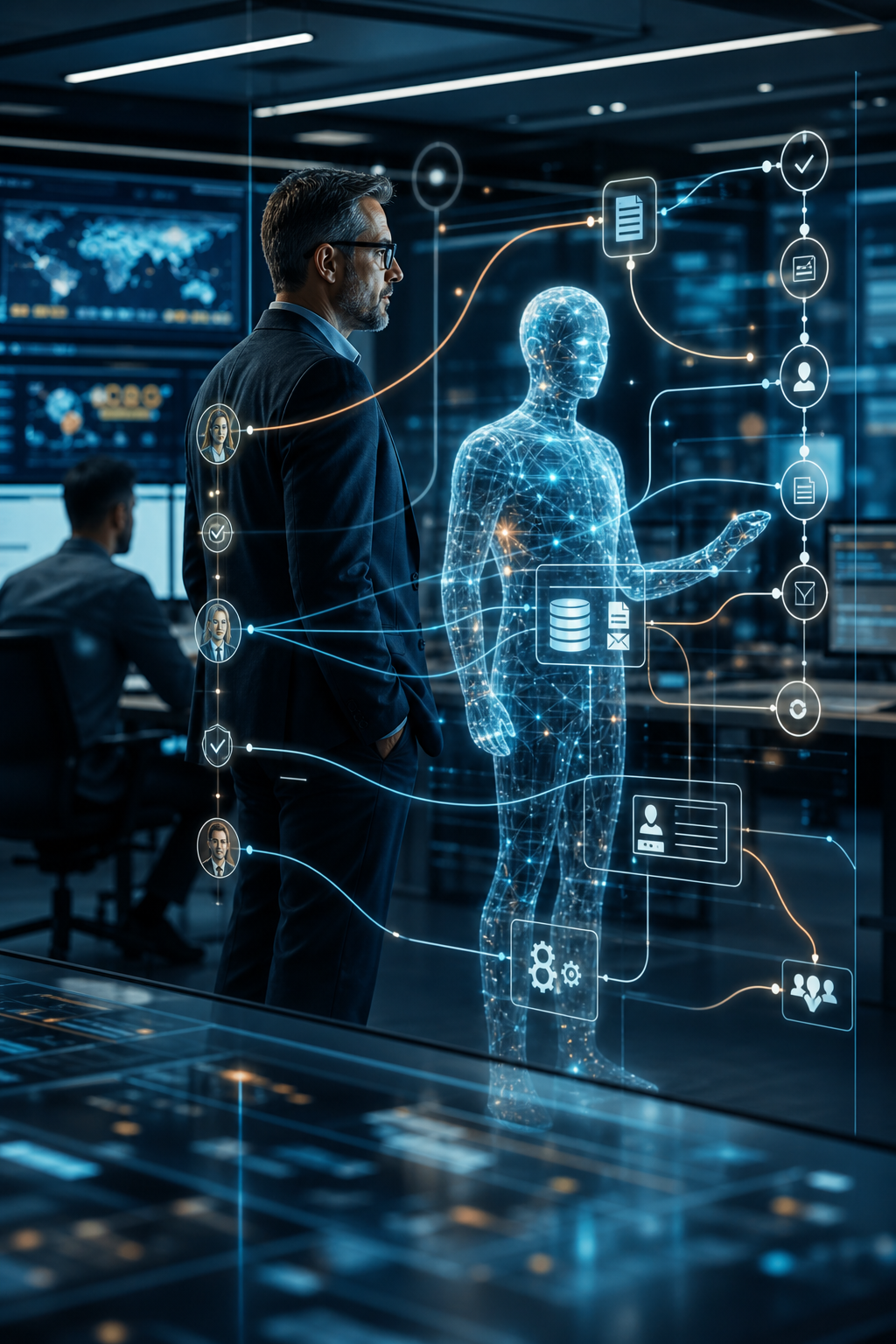
When AI Agents Become Digital Workers, Who Is Responsible for Their Actions?
AI agents are moving beyond answering questions to executing multi-step workflows, using tools, and making decisions in business systems. This shift toward autonomous digital workers creates accountability challenges, including identifying which agent acted, what data and permissions it used, and whether human approval was required.
Organizations may need stronger agent identities, monitoring, access controls, and evidence trails covering prompts, model versions, tool calls, and decisions. Effective AI governance will require clear human ownership and the ability to reconstruct and assess an agent’s actions.
The most important change in enterprise AI may not be that software can generate better answers.
It may be that software is increasingly being trusted to take action.

AI agents can now move through multi-step workflows, interact with business systems, use tools, and complete tasks without requiring a person to approve every individual step. As companies move from AI assistants toward autonomous agents, a new question is becoming difficult to avoid: who is responsible when an AI agent acts?
From Assistant to Digital Worker

Traditional AI tools usually wait for a person to ask a question and then provide an answer.
Agents are different.

They can receive an objective, determine a sequence of actions, interact with software, and continue working toward a result. This is why companies are increasingly describing them as digital workers rather than simple software features.
That change creates a new management problem.
A company may know which employee initiated an AI workflow, but it also needs to know which agent acted, what information the agent accessed, which tools it used, and what decisions occurred along the way.
The New Accountability Problem
Recent industry discussions are increasingly focused on this issue.
Gartner has predicted that by 2030 many large companies could formally assign senior technology executives responsibility for preserving evidence about AI activity. That evidence could include prompts, model versions, data sources, permissions, tool calls, human approvals, and decision records.
The idea is simple: if an AI system makes an important decision, a company should eventually be able to reconstruct what happened.
That is very different from simply keeping a traditional application log.
What If the Agent Makes the Wrong Decision?
Imagine an AI agent that can approve a transaction, send an email, update a customer record, or initiate another automated workflow.
If the result is wrong, saying “the AI did it” does not solve the accountability problem.
The organization still needs to determine who authorized the agent, what permissions it had, what information it received, whether a human review was required, and whether the system operated within its intended boundaries.
Recent enterprise discussions around agent governance are therefore moving toward stronger identity, monitoring, permissions, and evidence trails.
The New Digital Workforce Needs Management
This does not mean companies should stop using AI agents.
It means the management model needs to change.
Organizations deploying autonomous systems may need to treat agents as a new category of digital workforce — with defined responsibilities, access permissions, monitoring, performance measurement, and clear human ownership.
The goal is not to make agents incapable of acting. The goal is to make their actions understandable and accountable.
The Question Businesses Need to Answer
The next stage of AI adoption may therefore be less about asking:
“How many AI agents can we deploy?
”And more about asking:
“Can we prove what our agents did, why they did it, and who was responsible for the outcome?
”That question could become one of the defining issues of enterprise AI.
As AI agents move from experimental demonstrations into real business workflows, the companies that succeed may not simply be those with the most autonomous systems.
They may be the companies that know how to make autonomous systems visible, controlled, and accountable.