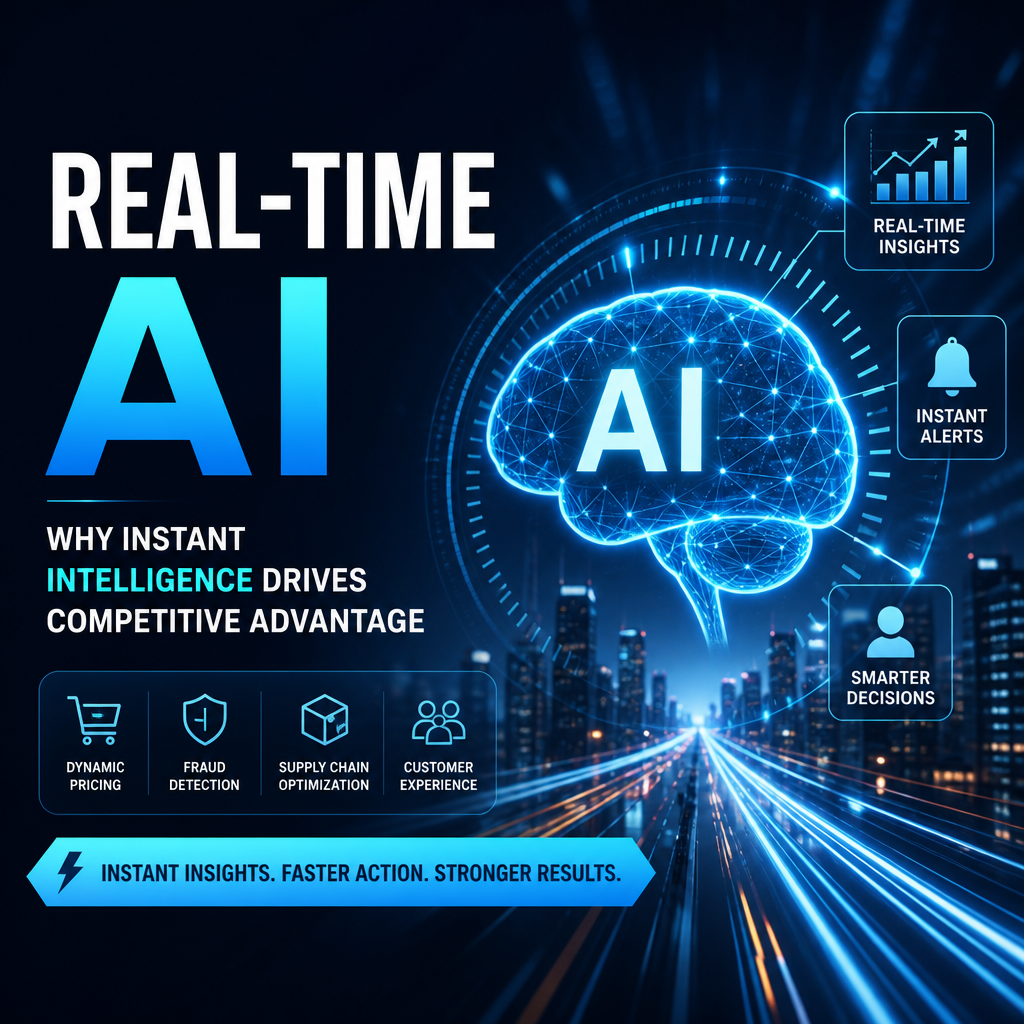
Real-Time AI: Why Instant Intelligence Drives Competitive Advantage
Real-Time AI: Why Instant Intelligence Is the New Competitive Edge
Businesses have always competed on information. The companies that understood customers, market shifts, and operational risks faster often gained an advantage. Today, however, traditional reporting and periodic analysis are no longer enough.
Real-time AI is changing how organizations make decisions by turning live data into immediate insights and actions. Instead of waiting for end-of-day reports or manual analysis, companies can identify opportunities, respond to problems, and personalize experiences as events unfold.

What Is Real-Time AI?
Real-time AI refers to artificial intelligence systems that process data continuously and deliver insights, predictions, or automated responses within seconds or milliseconds.
These systems can analyze information from sources such as:

- Customer interactions
- Website and app activity
- Financial transactions
- Supply chain sensors
- Social media and market signals
- Internal business applications
The goal is not simply to collect more data. It is to make that data useful at the moment when a decision matters most.
For example, an online retailer can detect that a customer is likely to abandon a shopping cart and immediately offer personalized assistance. A bank can identify suspicious transaction behavior while a payment is taking place. A manufacturer can recognize signs of equipment failure before production stops.

Why Speed Has Become a Business Advantage
In many industries, the value of information decreases quickly over time. A customer complaint addressed immediately can protect a relationship. The same complaint ignored for several days may result in a lost customer and negative public feedback.
Real-time AI helps organizations close the gap between knowing and doing. This creates several important advantages.
Faster Decision-Making
Traditional business intelligence often relies on scheduled reports. While those reports remain useful for long-term planning, they may be too slow for fast-moving situations.
Real-time AI gives decision-makers current information, allowing them to:
- Adjust prices based on demand
- Redirect inventory during supply disruptions
- Respond to emerging security threats
- Personalize marketing messages instantly
- Detect operational problems before they escalate
Faster decisions can reduce costs and help companies take advantage of short-lived opportunities.
More Personalized Customer Experiences
Customers increasingly expect businesses to understand their needs without making them repeat information. Real-time AI makes this possible by analyzing behavior and context as interactions occur.
A streaming service can recommend content based on what a viewer is watching now. A customer service platform can suggest responses based on the conversation. A travel company can provide relevant offers based on search activity and timing.
This type of personalization feels more natural because it reflects the customer’s current intent rather than relying only on historical profiles.
Improved Risk Management
Real-time AI is also transforming how organizations identify and manage risk. Instead of reviewing incidents after they happen, companies can monitor patterns and intervene earlier.
In cybersecurity, AI can flag unusual login activity or suspicious network behavior. In finance, it can detect potentially fraudulent transactions. In healthcare, it can help identify warning signs in patient data.
Early detection does not eliminate risk, but it gives teams more time to respond effectively.
Real-Time AI Across Industries
The applications of real-time AI extend across nearly every sector.
Retail and E-Commerce
Retailers use live analytics to optimize product recommendations, inventory, promotions, and customer support. AI can identify demand changes quickly and help prevent both stockouts and excess inventory.
Manufacturing
Connected machines generate continuous streams of operational data. Real-time AI can analyze this information to support predictive maintenance, improve quality control, and reduce unplanned downtime.
Financial Services
Banks and payment providers use instant intelligence for fraud detection, credit decisions, customer service, and market analysis. Automated systems can evaluate millions of transactions and identify unusual activity almost immediately.
Logistics
Shipping companies can use AI to monitor routes, weather conditions, vehicle performance, and delivery demand. This enables faster rerouting and more accurate delivery estimates.
The Challenges of Instant Intelligence
Implementing real-time AI is not as simple as adding a new software tool. Organizations must build the right technical and operational foundation.
High-quality data is essential. Incomplete, inaccurate, or delayed data can produce unreliable recommendations. Businesses also need strong security controls, clear governance policies, and systems capable of processing information at scale.
Trust is another important factor. Employees should understand how AI reaches conclusions and when human review is required. The most effective approach often combines automated recommendations with human judgment, especially in high-impact decisions.
Building a Real-Time AI Strategy
Companies can begin by identifying decisions where speed has the greatest value. Rather than applying AI everywhere at once, they can focus on specific opportunities, such as fraud prevention, customer retention, or predictive maintenance.
A practical strategy includes:
- Defining a measurable business objective
- Connecting reliable, relevant data sources
- Choosing a focused pilot project
- Establishing privacy and governance standards
- Measuring results and improving continuously
The Future of Competitive Advantage
Real-time AI will increasingly become a standard capability rather than a specialized advantage. As more companies adopt instant intelligence, the competitive gap will shift toward execution: who can respond more accurately, responsibly, and consistently.
Organizations that combine live data, intelligent automation, and human expertise will be better positioned to adapt to changing markets. In a business environment where conditions can change in moments, the ability to understand and act immediately may be the defining competitive edge.