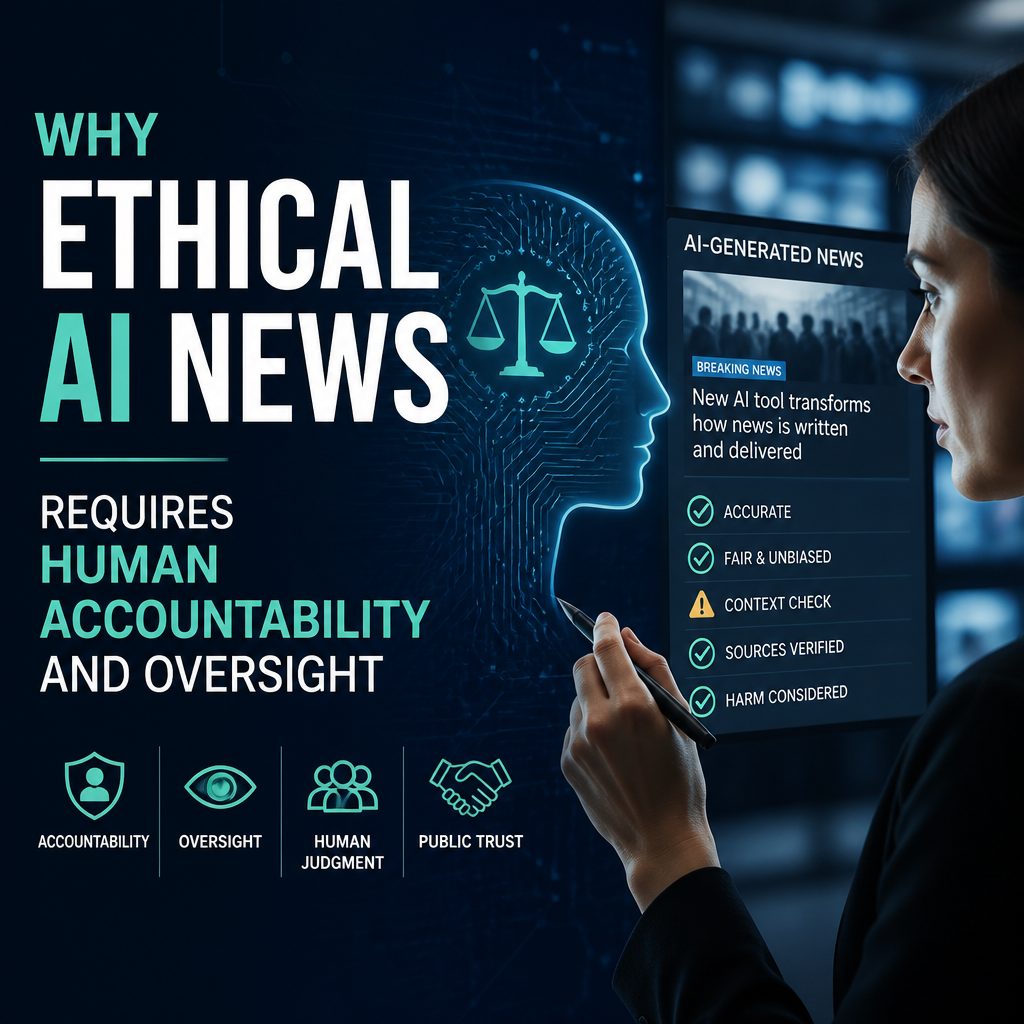
Why Ethical AI News Requires Human Accountability and Oversight
Why Ethical AI News Requires Human Accountability
Artificial intelligence is changing how news is gathered, produced, and distributed. Automated tools can summarize reports, analyze large datasets, translate interviews, and identify emerging trends within seconds. These capabilities offer valuable support to journalists and newsrooms.
However, speed and efficiency do not guarantee accuracy or fairness. That is why ethical AI news requires human accountability at every stage of the editorial process.

AI systems can assist with journalism, but they cannot replace the judgment, responsibility, and public duty of human reporters and editors.
The Limits of AI-Generated Information
Artificial intelligence does not understand facts in the same way people do. It identifies patterns in data and generates likely responses based on its training. As a result, an AI tool may produce content that sounds convincing while containing factual errors, missing context, or invented details.

These problems can be especially damaging in news coverage. A false statement about a public official, health emergency, court case, or financial event can spread rapidly and influence real-world decisions.
Common risks include:

- Incorrect names, dates, or statistics
- Misleading summaries of complex events
- Unverified claims presented as fact
- Outdated information
- Biased or incomplete perspectives
- Fabricated sources or quotations
Human oversight is essential because readers need more than fluent writing. They need reliable information supported by evidence.
Accountability Cannot Be Automated
When a news article contains an error, someone must take responsibility for publishing it. An algorithm cannot explain an editorial decision, apologize to affected communities, or correct a story in a meaningful way.
Human accountability gives journalism a clear chain of responsibility. Editors and publishers must know:
- Which tools were used
- How AI-generated material was checked
- Who approved the final article
- How corrections will be handled
- Whether affected individuals had an opportunity to respond
Without these safeguards, news organizations may hide behind technology when mistakes occur. Ethical journalism requires the opposite approach: technology should support professional responsibility, not weaken it.
Transparency Builds Reader Trust
Readers deserve to know when artificial intelligence has played a significant role in producing a news report. Transparency does not require revealing every technical detail, but news organizations should explain how AI was used and what human review took place.
For example, a newsroom might disclose that AI helped organize public records while journalists verified the findings and wrote the final story. This reassures readers that the article was not published without supervision.
Transparency is also important when AI is used to create:
- Automated summaries
- Translated reports
- Synthetic images or audio
- Data visualizations
- Personalized news recommendations
Clear disclosure allows audiences to evaluate information more thoughtfully and recognize the difference between reporting and machine-generated material.
Protecting Fairness and Representation
AI systems learn from existing data, and existing data often reflects social inequalities. If a tool is trained on biased sources, it may repeat harmful assumptions or overlook certain communities.
For instance, an automated system could prioritize stories that attract the most clicks while giving less attention to local issues, minority groups, or people without a strong online presence. It might also describe similar events differently depending on the identities involved.
Human journalists must challenge these patterns by asking:
- Whose perspective is missing?
- Are sources being represented fairly?
- Does the language reinforce stereotypes?
- Could this coverage cause unnecessary harm?
- Is the story important, or merely attention-grabbing?
Ethical AI news depends on editorial judgment that considers both accuracy and social impact.
Human Judgment Protects the Public Interest
Good journalism is not simply the process of collecting information. It involves deciding what matters, determining which sources are credible, understanding context, and serving the public interest.
AI can help identify connections in large datasets, but it cannot fully understand the human consequences of a story. A journalist may recognize when publishing a private detail could endanger someone, when a vulnerable source needs protection, or when a sensational headline could inflame public tension.
These decisions require empathy, experience, and ethical reasoning. They cannot be reduced to a set of automated instructions.
Building Responsible Newsrooms
News organizations can adopt practical standards for responsible AI use. These may include:
- Requiring human review before publication
- Verifying every important claim against reliable sources
- Labeling substantially AI-generated content
- Protecting confidential and personal information
- Auditing tools for bias and recurring errors
- Training journalists in AI literacy and digital ethics
- Maintaining a clear correction policy
Such policies make innovation safer and more accountable. They also help journalists use AI as a research and production aid rather than treating it as an unquestionable authority.
The Future of Ethical AI News
Artificial intelligence will likely become a regular part of modern newsrooms. The central question is not whether journalists should use AI, but how they should use it responsibly.
Ethical AI news places people at the center of every important decision. Human reporters and editors must remain accountable for accuracy, fairness, transparency, and the consequences of publication.
Technology can make journalism faster, but only human responsibility can make it worthy of public trust.